
The Memory Keeper: Turning a Season of Beach Days into a Book Your Kids Will Reread
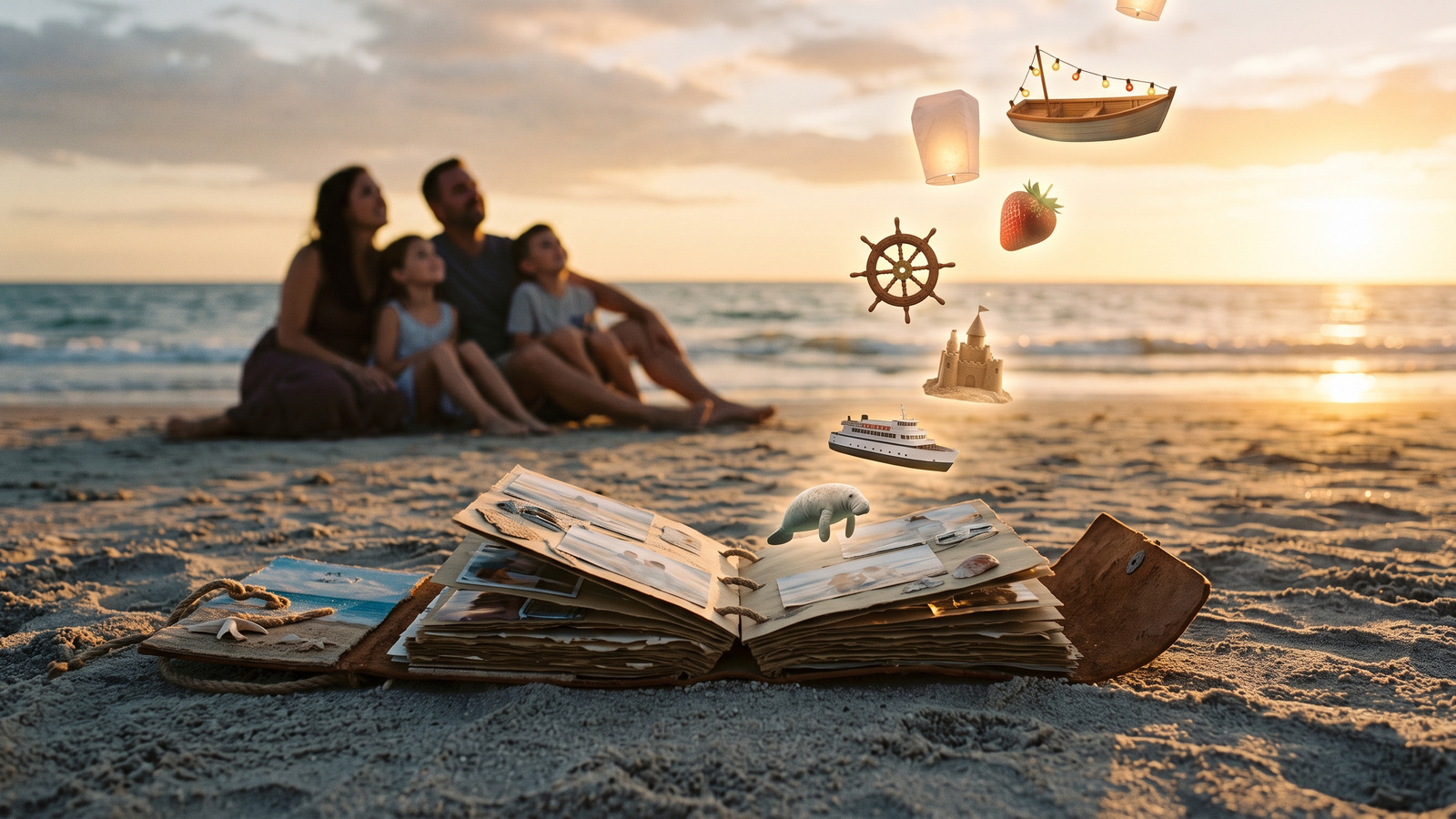
One hundred articles ago, this site opened with a promise dressed as a listicle: that a family who learned this coast: its state symbols and spoonbills, its tides and Tocobaga, its manatee winters and mermaid theaters: would end up with something better than outings. They'd end up with a childhood. This final article is about what to do with it. Because here is the quiet heartbreak every parent knows: the seasons this site helped you fill are already blurring: the ferry mornings run together, the exact wording of the four-year-old's manatee theory is going, and the eleven thousand photos in your pocket are, functionally, a landfill with a search bar. The memory keeper is the fix: one simple system, one physical book per year, built for the only audience that matters: your own kids, ten years from now, on the floor by the shelf, reading their childhood back.
Why the book beats the cloud
The argument is behavioral, not sentimental: books get reread and archives don't. A physical volume on a reachable shelf is opened by children unprompted: rainy afternoons, homesick nights, the pre-bedtime stall: and rereading is where memory actually consolidates: the kid who has read "the day the horseshoe crabs came" fifteen times owns that day permanently, in a way no cloud folder ever grants. The camera roll fails at exactly this: infinite capture, zero revisit: eleven thousand images is a number, not a childhood. The book also holds the analog layer phones can't: the handwriting changing year over year (the single most devastating feature at year ten), the shell-jar slip taped beside its Sunday, the actual sand in the binding of the Fort De Soto spread. And it survives every platform migration, password loss, and format death that will eat this decade's digital archives: the technology of the bound page has a five-century uptime record. Print small, print monthly, bind annually: the shelf does the rest.
The five feeds, run lazily on purpose
| The feed | The rhythm | The trick |
|---|---|---|
| Journal pages | Photocopy quarterly | Originals stay with their authors forever |
| The weekly photo | Print 10 monthly, ten minutes | One per week: curation IS the memory work |
| The paper trail | Shoebox, continuous | If it survived the beach bag, it's a candidate |
| The quote page | Written the day it's said | The un-reconstructable feed: fridge notepad feeds it |
| The traditions log | One line per ritual occurrence | The first-cracks and jar readings, dated |
The system's design principle is sustainable laziness: every feed runs on under ten minutes a month, because the memory books that exist were all built by tired parents and the ones that don't were all designed by ambitious ones. The December assembly is the only real session: an afternoon, the shoebox dumped, the kids voting pages in and out (their co-editorship is why they'll reread it: it's partly THEIR book), glue sticks, the analog-day energy, done. Photo books printed from an app count fully for the photo layer: paste the paper trail into and around them: the hybrid is most families' steady state.
The book as the site's final lesson
Notice what the memory keeper actually is: every practice this site spent one hundred articles installing, closing its own loop. The journals were feeds all along; the traditions this cluster built: the walks, the beach Sundays, the December rituals: generate the log; the field trips produce the paper; even the friend map and phenology wheels are pages waiting for December. A family that ran this curriculum was building the book before they knew the book existed. And the book returns the favor at compound interest: the child who rereads their childhood learns, at the deepest level available, the thesis under all one hundred articles: that an ordinary family, on an ordinary coast, paying attention on purpose, was enough: that the state bird debates and sandcastle holes and thermos boardwalks were, all along, what a rich life looks like from inside. Some families will hear that as gratitude, some as grace, some as both: the book doesn't argue: it just shows the evidence, in everyone's own handwriting.
The Little Naturalist activity
Commission the year's cover as the final family artwork: each December, before assembly, the kids co-create one cover page: the year's number, one drawing each of their single favorite moment (no consulting the photos first: the unprompted choice IS the data), and the family's one-line title for the year, negotiated at dinner ("The Year of the Manatee," "The Year We Found the Burrowing Owl"). Ten years of covers, laid side by side, is the family's whole saga in kid-drawn miniature: and the negotiation over the title is the year's true final exam: watch what they choose, and notice it's never the expensive thing.
Questions families ask
We're starting late: the kids are already 8 and 11. Worth it?
The best time was the first storytime; the second-best time is this month: older kids make BETTER memory books (real co-editors, real handwriting, real opinions), and the retroactive volume-one: one afternoon, the camera roll's greatest hits, everyone's told-from-memory captions: is a beloved genre of its own. The rereading years are still all ahead.
One book or one per kid?
The family book is the spine (one system, sustainable), with the graduation move at eighteen: each kid receives a bound copy or the scanned edition of the full set. Kids who want personal volumes keep their own journals anyway: that was the design: the originals were always theirs.
What about the digital layer: backups, videos, the grandparents far away?
Belt and suspenders: scan or photograph the finished pages once (one more December ritual: ten minutes), which backs up the book AND produces the shareable edition for the grandparents and the old-home people. Videos live digitally by nature: the book's job is to be the index that makes anyone want to go find them.
Does the memory book replace anything this site taught, or just collect it?
Neither: it completes it. The journals taught noticing, the traditions taught rhythm, the hundred outings filled the years: the book teaches the last skill, which is keeping. A family that notices, rhythms, and keeps has everything this coast: and this site: ever wanted to give them. Go start the shoebox: the ferry stub from this weekend is already a page.
Questions families ask
What is a family memory book?
One physical book per season or year that gathers the family's actual life: the journal pages, the printed photos, the ferry stubs and festival wristbands, the quotes written down the day they were said. Not a scrapbooking hobby: a simple system with a monthly print ritual and a December assembly, built to be reread.
Why make a physical book instead of keeping photos on a phone?
Because rereading is the whole point: a book on the shelf gets opened by children unprompted for years; a camera roll of eleven thousand images gets scrolled by no one. Physical pages also hold what phones can't: the handwriting, the flattened penny, the sand that never quite leaves the binding.
What goes in a family memory book?
The five feeds: the kids' journal pages (photocopied, originals stay in their books), one printed photo per week, the paper trail (tickets, stubs, badges, the season's best drawings), the quote page (things actually said, dated), and the traditions log: the year's first-cracks, gratitude-jar readings, and walk-census highlights.
How do you actually keep up with it?
One rule: the monthly ten-minute print ritual (pick the month's ten photos, print, drop in the box with the month's paper), then one December afternoon assembling the year with the kids as co-editors. Perfection is the enemy: the book that exists beats the beautiful one that doesn't.
Sources
More from the Bae
 Learn
LearnNature Journaling for Kids: The One-Notebook Habit That Changes Every Walk
Nature journaling for kids: the one-notebook habit, prompts by age, and why writing down three observations changes every Tampa Bay walk.
 Explore
Holidays on the Water: Boat Parades, Beach Trees, and December Traditions
December on Tampa Bay: lighted boat parades, beach Christmas traditions, sandy Santa photos, and the water-town holiday calendar families build on.
 LearnCornerstone
Florida's State Symbols, Explained for Kids: Every Animal, Flower, and Song, and the Stories Behind Them
Every Florida state symbol explained for kids: the panther, manatee, mockingbird, zebra longwing, and more, with the stories and the flamingo debate.