
Burrowing Owls: Tiny Owls, Big Personalities, and How to Visit Them Respectfully
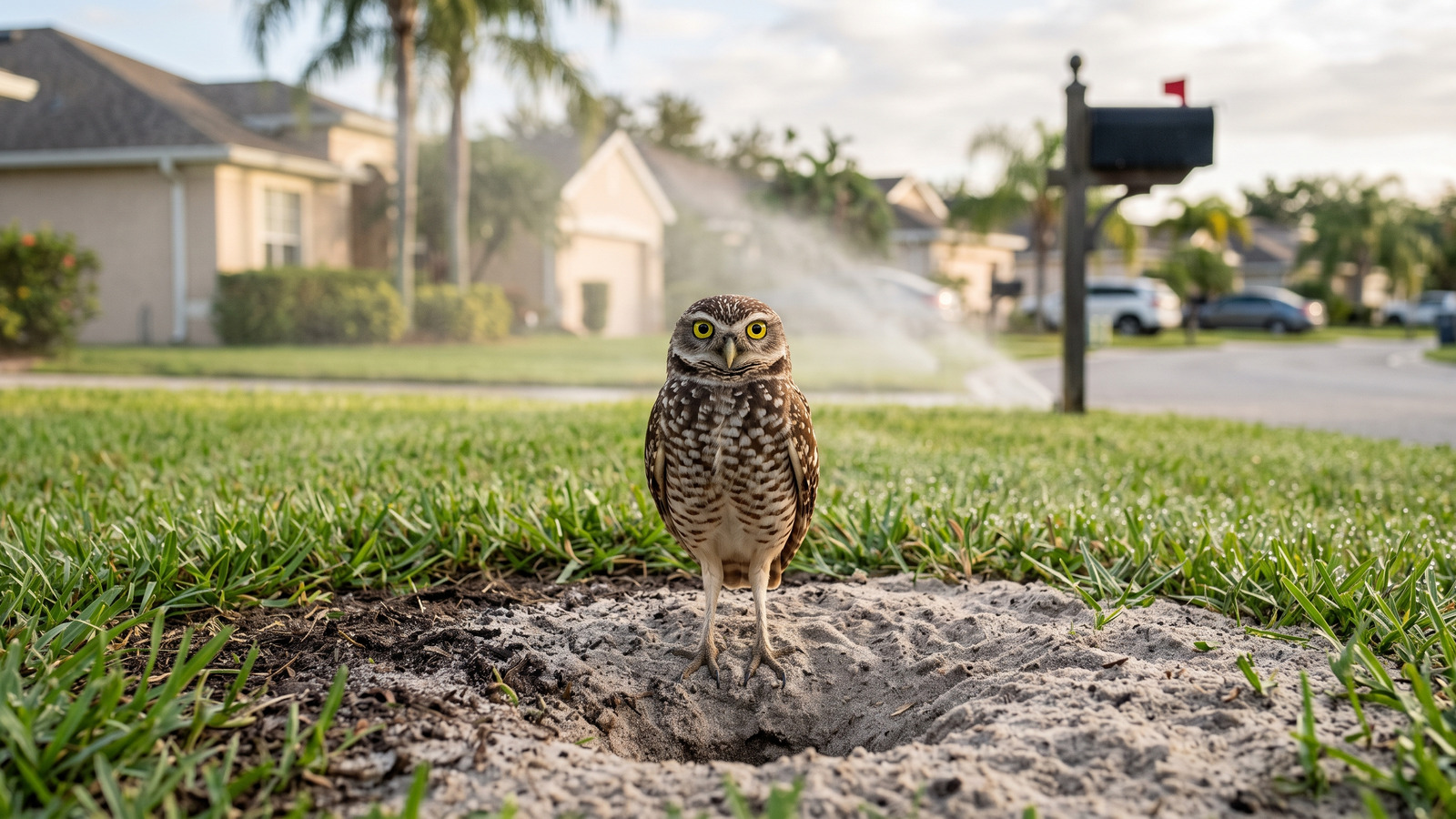
Somewhere in Cape Coral right now, on an ordinary suburban corner lot, a bird the height of a soda can is standing at the mouth of a hole it dug itself, glaring at a passing jogger with the full authority of a building superintendent. Long legs. Lemon-yellow eyes. Eyebrows that suggest it has seen your permit application and found problems. The burrowing owl is the only owl your kids will ever meet at ankle height in broad daylight, and Florida happens to hold the friendliest place on Earth to meet one.
An owl that broke all the owl rules
Everything kids think they know about owls, this bird contradicts on purpose. Nocturnal? Burrowing owls hunt and socialize in daylight, standing sentry through the afternoon. Trees? They live underground, in tunnels they excavate themselves, several feet deep, which distinguishes Florida's subspecies from its western cousins, who mostly sublet from prairie dogs and tortoises. Solemn and mysterious? A burrowing owl's threat display involves bobbing like it's doing tiny squats, and when cornered in the burrow, chicks can produce a rattle that impersonates a rattlesnake: a nine-inch bird doing a venomous snake impression from inside the ground. Add the decorating habit (pairs line the burrow entrance with shells, bottle caps, foil, and whatever else catches the eye) and you have, ounce for ounce, the most personality in Florida wildlife.
The serious side: the owl is listed as threatened in Florida, its open-prairie habitat mostly gone to development, which makes its suburban survival strategy both charming and precarious. The burrows are protected by law, occupied or not, exactly like the tortoise burrows your kids already know not to touch.
Cape Coral: the accidental owl capital
When Cape Coral was platted decades ago, developers cleared and mowed thousands of lots that then sat empty, and burrowing owls looked at that endless artificial prairie and moved in. Today the city hosts the largest burrowing owl population in Florida, thousands of burrows among the houses, marked with wooden stakes and T-shaped perches, defended by an adoring volunteer group (Cape Coral Friends of Wildlife) and celebrated each February with a Burrowing Owl Festival: tours, kid activities, and the city at maximum owl pride. Families can see owls from public sidewalks within minutes of arriving, which is the whole trick: the birds tolerate the neighborhood's rhythms precisely because the neighborhood keeps its distance.
| The visit, planned | Details |
|---|---|
| Drive from Tampa Bay | About 2 hours south; pair with a Sanibel or Naples day |
| Best season | February through July; chicks peak April to June |
| The festival | Late February, run by Cape Coral Friends of Wildlife |
| Where to look | Marked burrows on public lots; T-perches flag them |
| Where to stand | Sidewalks and roadsides, outside the marker stakes |
| The distance rule | If the owl stands tall and bobs, you're too close; back up |
The etiquette, taught as insider knowledge
Kids follow rules better when the rules are secrets of the trade. So: photographers and biologists judge distance by the owl's own signals: a relaxed owl loafs, preens, and ignores you; an alarmed one stands tall, bobs, and stares. The moment the posture changes, you've found the line, and the pro move is one step back until the owl loses interest in you. Never walk between marker stakes, never flush an owl to see it fly, keep dogs leashed and well off (to a ground owl, every dog is the ancient enemy), and no food, ever, for all the reasons that rule repeats across this series. A family that watches twenty minutes from the sidewalk will see sentry changes, food deliveries, and the squat-bob comedy. The burrow line rewards patience with theater.
Closer to home
Tampa Bay proper offers only scattered, come-and-go burrowing owl records: pasture country and prairie preserves inland hold occasional pairs, and any local sighting is a genuine event for the family life list. Treat Cape Coral as the destination and any hometown owl as a lottery ticket. Meanwhile, the ecological cousin lesson is free at home: the gopher tortoise burrows at Boyd Hill run the same underground-apartment economy, and out west, burrowing owls are among the 350 tenants. Your kids already know the landlord.
The Little Naturalist activity
Owl architecture study: after (or before) a Cape Coral visit, have kids design their own burrow on paper: tunnel length, nest chamber, and, critically, the entrance decorations, since real owls curate shells, caps, and shiny litter at the door. Then the research question: why might an owl decorate? (Leading theories involve signaling occupancy and attracting insect prey; science genuinely isn't settled.) A question adults can't fully answer is the best souvenir a young naturalist can bring home.
Questions families ask
What do burrowing owls eat?
Insects first (mole crickets and beetles by the hundreds), plus lizards, frogs, and small rodents, hunted on foot, from perches, and in short flights, at all hours. A family of owls is measurable pest control, one more reason Cape Coral neighborhoods champion their lots' residents.
Why do they stare and bob at people?
The stare is standard sentry work; the bob is a threat-assessment behavior, effectively the owl triangulating on you. Read together, they're a politeness meter: calm stare, you're fine; tall posture plus bobbing, you've overstayed. Few animals grade your manners this legibly.
Could burrowing owls move into our neighborhood?
If you're in open, mowed, low-traffic country, it's not impossible; starter burrows (a sloped hole with a T-perch) have coaxed pairs in parts of southwest Florida. Realistically, Tampa Bay families should visit rather than recruit, and pour the landlord energy into native plants and the tortoises we do have.
Is the festival worth the drive with young kids?
Yes, calibrated: the festival supplies guided viewing, scopes aimed by volunteers, and kid programming, which beats freelancing your first visit. Go down in the morning, owl through midday, and finish with an ice cream and the drive home during nap. It's the best two-hour-radius wildlife day this side of manatee season.
Questions families ask
Where can families see burrowing owls in Florida?
Cape Coral, about two hours south of Tampa Bay, hosts the state's largest population, with thousands of burrows scattered through neighborhoods and marked with T-perches. Smaller colonies dot Florida's prairies and pastures. In Cape Coral the owls are famously visible from sidewalks, which is exactly where visitors should stay.
Do Florida burrowing owls really dig their own burrows?
Yes, and it makes them unusual: western burrowing owls mostly move into holes dug by prairie dogs and tortoises, while Florida's subspecies digs its own, kicking sand out backward with those long legs. A pair can excavate a tunnel several feet long, then decorate the entrance, genuinely, with found objects.
Are burrowing owls protected?
Florida lists the burrowing owl as state threatened, and both the birds and their burrows are protected by law. That means no flushing them, no crowding, no tampering with a burrow even if it looks empty, and dogs on leashes and at distance in owl neighborhoods.
When is the best time to see burrowing owl chicks?
Nesting season runs roughly February through July, with the comedy peak in April through June, when broods of fuzzy chicks stand at the burrow mouth like a tiny disapproving committee. Cape Coral's Burrowing Owl Festival each February opens the season.
Sources
More from the Bae
 Learn
LearnThe Gopher Tortoise: Florida's Little Landlord and the 350 Neighbors in Its Burrow
The gopher tortoise digs burrows that shelter 350 other species. Where families can see Florida's little landlord, and the never-put-it-in-water rule.
 LearnCornerstone
Birding with Kids Around Tampa Bay: The Starter Guide (Binoculars Optional)
How to start birding with kids around Tampa Bay: the big easy birds, the free Merlin app, five starter spots, and habits that make it stick.
 Learn
LearnThe Great Florida Birding Trail, Family Edition: Five Easy Stops Near Tampa Bay
The Great Florida Birding and Wildlife Trail links 500+ sites statewide. The five easiest family stops near Tampa Bay, with boardwalks and bathrooms.