
Nature Journaling for Kids: The One-Notebook Habit That Changes Every Walk
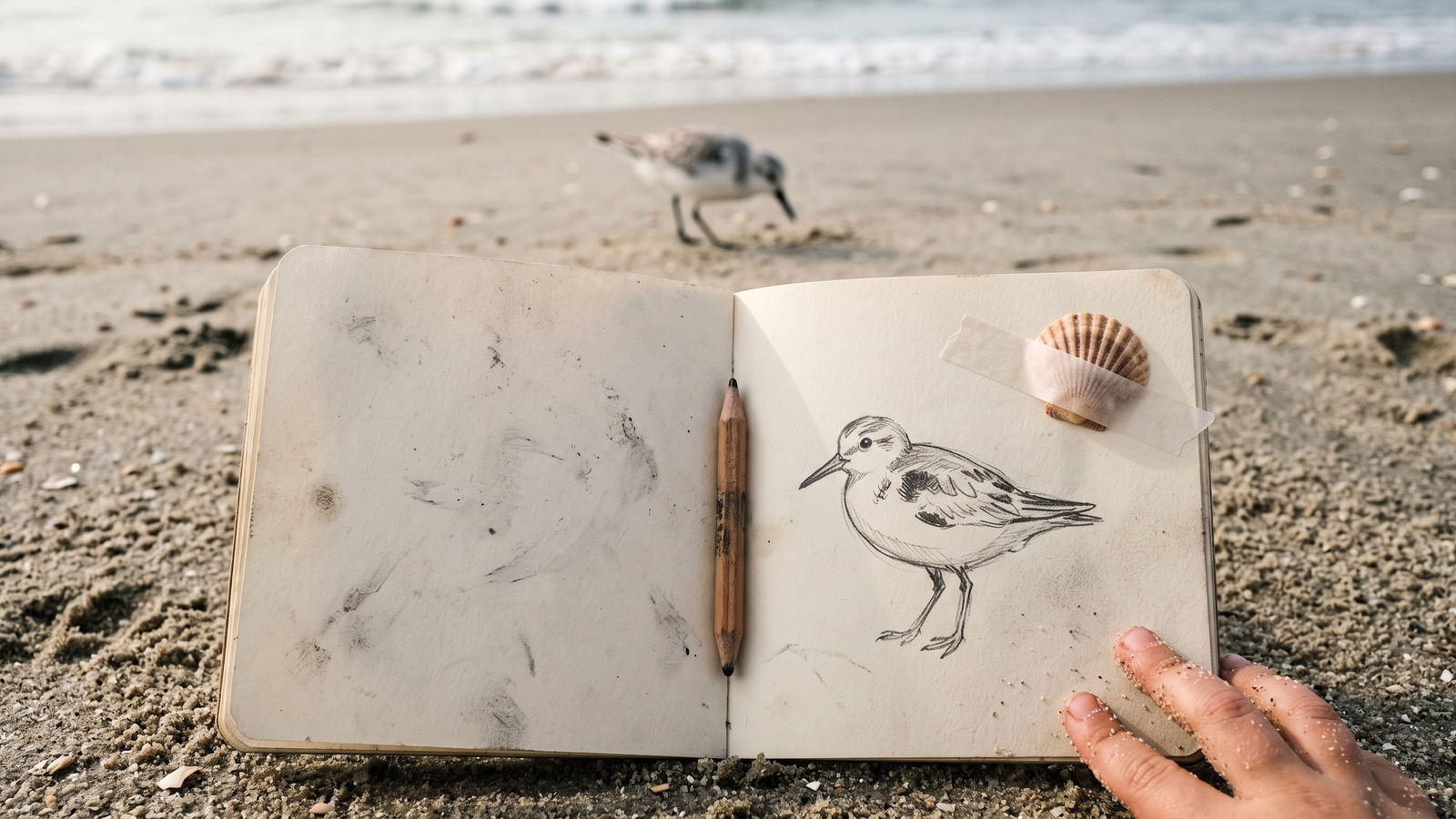
The most powerful piece of educational technology on this coast costs three dollars, runs without batteries, survives sand, and has been field-tested for four centuries by every naturalist whose name your kids will ever learn. The pocket notebook: which, handed to a child with one small ritual attached, performs a quiet miracle: it converts walking into noticing. The same beach that was a snack-delivery interval becomes a place where the tide line is hiding evidence, the sanderlings have countable field marks, and the afternoon sky is assembling something worth a hurried sketch. This article is the manual for the cheapest upgrade in family education: the one-notebook habit.
Why a notebook outperforms a camera
The case, briefly, because a phone camera seems to do the same job faster: it doesn't, and the difference is the point. A camera captures in a quarter second, which is exactly why nothing sticks: the looking ends when the shutter clicks. A drawing takes four minutes, and those four minutes are where the learning lives: to draw the horseshoe crab is to discover it has a hinge; to sketch the mangrove is to find the root snorkels you'd have walked past. Attention is the scarce resource in a child's education, and the notebook is an attention-harvesting machine dressed as a school supply. The photos still happen (the three-photo assignment has its place): but the page is where an outing becomes an observation, and observation, as every article in this series keeps whispering, is the whole trade of the naturalist.
The setup and the prompts
The kit: pocket notebook (spiral survives beach bags best), pencil (pens die in humidity, markers bleed), a gallon zip bag as the weatherproof garage, and optionally a glue stick for the found-flat treasures: a feather, a seaweed pressing, the ferry stub. The header ritual: date, place, weather, tide if coastal (the chart-reading habit, smuggled in). Headers turn pages into data: two years later, the family can answer when the spoonbills showed up last year, because somebody's header says so.
| The age | The prompt that works | A Tampa Bay page |
|---|---|---|
| 3-5 | Draw one thing you found; adult writes their words | The shell, scribbled, with "it was loud" recorded verbatim |
| 6-9 | I notice / I wonder / it reminds me of | Sanderling sketch; "why do they run from waves"; "wind-up toy" |
| 10-13 | Add counts, measurements, maps | Tide-pool census: 11 hermit crabs, water temp, sketch map |
| Teens | Field questions + follow-up research | "Why does the seagrass stop at that depth" plus the library answer |
The cadence: one page per outing, five to ten minutes, ideally at a ritual moment (the snack pause, the pier bench, the ferry ride home). One honest page beats five rushed ones, and a skipped day costs nothing: the notebook keeps no attendance.
Where the pages pay off
The journal is the connective tissue of everything this site teaches: it's the capture step of every field trip, the data log of every citizen science project, the activity half of the junior ranger kit, and the evidence spine of the homeschool portfolio (evaluating teachers consistently rate a year of dated field pages above a stack of worksheets, because it shows the one thing worksheets can't: a child thinking). And it compounds: the second year's pages argue with the first's ("the tide pools had more urchins last February": now that's a question), which is how children discover that knowledge isn't a stack of facts but a long conversation with a place.
The Little Naturalist activity
Run the one-square-foot study: on any shore, trail, or backyard patch, frame a square foot with string or a bent hanger, and journal only what's inside it for ten full minutes: every shell fragment, ant, root, and hole, drawn or counted. Repeat the same square (or the same kind of square) monthly. The constraint is the teacher: a child who thought the beach was "sand" discovers it's a crowded neighborhood, and the monthly repeats turn one page into a longitudinal study: the smallest possible version of what the bay's scientists do with the whole estuary.
Questions families ask
My child refuses to draw. Dead end?
Not remotely: words, lists, counts, and taped-in finds fill pages just as legitimately, and the "I notice" frame runs fine in prose. Many reluctant drawers thaw after a season of watching a parent sketch badly without shame: which is the real assignment of the parent's journal.
Wet notebook, tears. Prevention?
The zip-bag garage, a backup notebook in the glove box, and the house rule that a ruined book is a rite, not a tragedy: dry it, save what survives, staple the casualty into the new book's first page as a war story. Pencil survives soakings far better than ink: another vote for the humble tool.
Digital journaling: allowed?
Teens logging iNaturalist observations are journaling, full stop, and the app's records feed real science. For younger kids, paper wins on attention (no screen adjacency) and on the shelf: a filled notebook is an object a childhood can keep. Many families land on paper in the field, apps for the uploads after.
How is this different from a diary?
A diary looks in; the journal looks out: and that outward posture is why it changes walks. Feelings sneak in anyway ("best day" appears on more pages than any bird), and that's fine: the naturalists' journals history kept are the ones where the observer occasionally showed through.
Questions families ask
What is nature journaling for kids?
A pocket notebook, a pencil, and a simple habit: on any walk or beach day, the child records the date, place, and weather, then captures a few observations in drawings, words, or numbers. It's the oldest tool in natural history, scaled to a seven-year-old's pocket.
Does my child need to draw well to nature journal?
No, and neither did Darwin: journal drawings are records, not artwork. The standard is 'enough to remember by,' and the three-frame prompt (I notice, I wonder, it reminds me of) gives even reluctant artists a page that works entirely in words.
What should kids journal in Tampa Bay specifically?
The bay's rhythms hand out material: tide lines and what they strand, shorebirds and their field marks, shell finds, mangrove roots, cloud stacks before the summer storm, and the same backyard square watched across seasons. One good observation per outing beats ten rushed ones.
How do parents keep the journal habit alive?
Journal alongside them, badly and cheerfully: the parent's mediocre pelican sketch is the permission slip. Keep sessions short (five to ten minutes), tie them to a ritual moment like snack time, and never grade a page.
Sources
More from the Bae
 LearnCornerstone
Birding with Kids Around Tampa Bay: The Starter Guide (Binoculars Optional)
How to start birding with kids around Tampa Bay: the big easy birds, the free Merlin app, five starter spots, and habits that make it stick.
 Explore
Tide Pooling Around Tampa Bay: Where Kids Can Meet Sea Stars and Hermit Crabs
Tide pooling around Tampa Bay: winter's negative low tides, the best flats at Fort De Soto and Honeymoon, and the wet-hands manners that protect the pools.
 Protect
Seagrass, Explained for Kids: The Underwater Meadows Everything Depends On
Seagrass is the underwater meadow feeding Tampa Bay: nursery for most of our fish, manatee salad, and oxygen factory. The kid-level tour.