
The Evening Walk: Why the Simplest Habit on the Coast Is the Best One
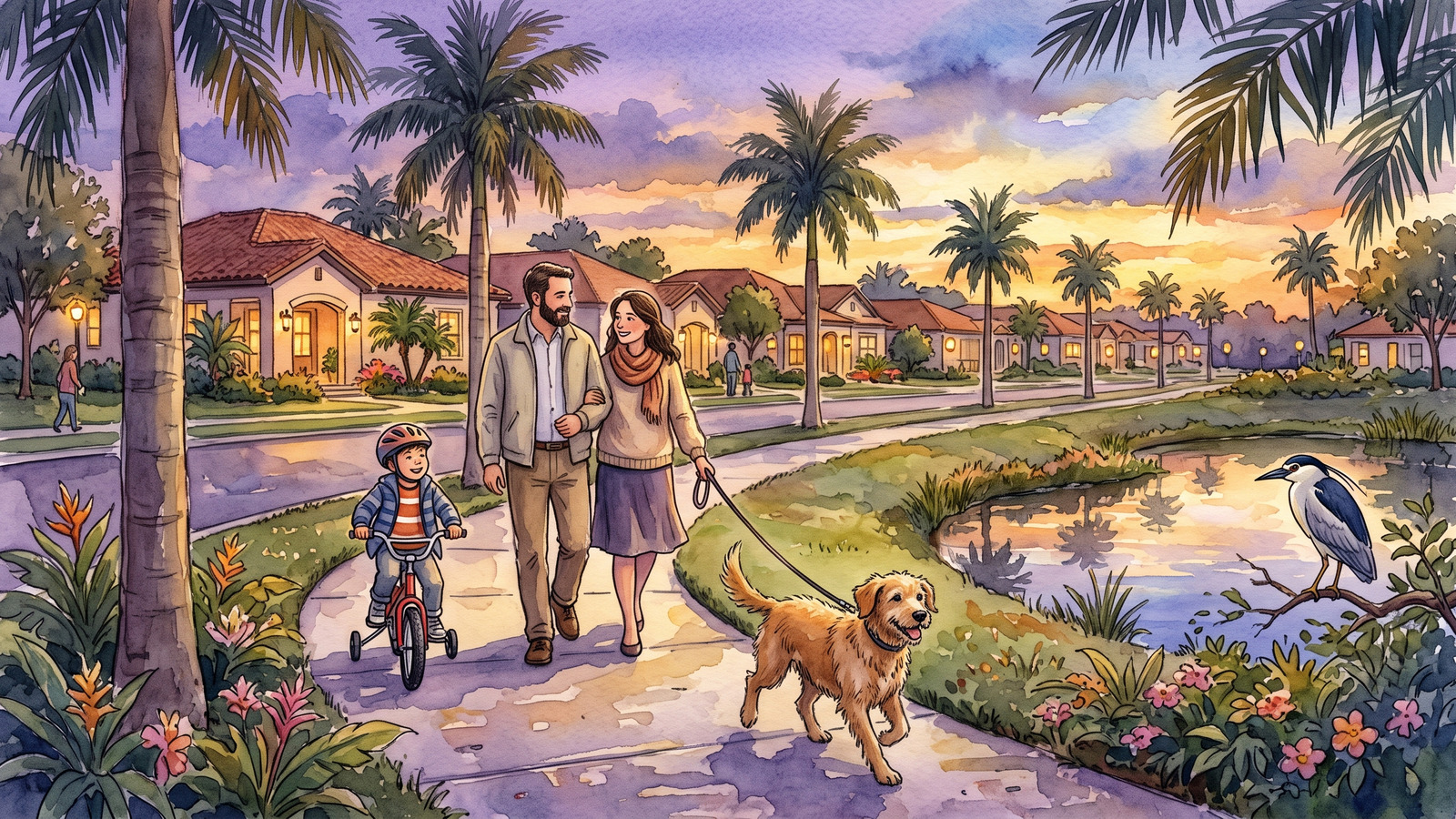
If this site could install one habit in every family on this coast: before the beach kit, before the tide chart, before all one hundred articles: it would be this one, and it costs twenty minutes and zero dollars: after dinner, the family walks. That's the entire technology. No gear, no destination, no sign-ups. And yet ask the households that keep it (you know them: the ones you see passing your window at dusk like clockwork, kids orbiting on bikes) and they'll tell you, with the slight embarrassment of people describing something too simple to defend, that the walk is somehow the best part of the day: the hour the arguments dissolve, the day's real news finally surfaces, and the family returns home softer than it left. The last cluster of the Educational 100 ends its habits section here on purpose: the evening walk is the smallest possible dose of everything this site believes.
Why walking unlocks kids
Every parent has run the failed interview ("how was school?" "fine") and the walk wins where the interview loses for reasons worth knowing: side-by-side beats face-to-face (eye contact reads as interrogation to kids and especially teens: parallel motion removes the spotlight, and the hard topics: the friend trouble, the fear, the confession: consistently choose the walk to surface), motion regulates (the fidget that derails the dinner table is the walk's fuel: wiggly bodies think better moving, a finding as old as Aristotle's strolling students), and the route does the hosting (the neighbor's new dog, the osprey nest, the sprinkler rainbow supply low-stakes conversation that warms up the real kind). Parents who add one discipline: answer what surfaces without maximizing it (the confession met with calm gets a sequel; the one met with a lecture doesn't): find the walk becomes the family's confessional booth, therapist's couch, and news wire, disguised as exercise.
The coast pays an evening bonus
| The walk's ingredient | The coastal upgrade |
|---|---|
| The light | Golden hour, nightly, sunset at the street's end |
| The air | The post-storm-clock cool: summer's daily reward |
| The cast | Night herons, bats, the neighborhood's evening shift |
| The seasons | Front season's sweaters, turtle season's dark-sky manners |
| The weekend edition | The beach or quiet-spot walk, full length |
| The Sunday edition | The gratitude walk: same legs, deeper agenda |
The ordinary-block walk is the nightly workhorse, but the region tunes it: summer's walk slides post-storm into the cooled gold hour, winter's walk starts earlier and catches the year's kindest light, and beach-adjacent families inherit the champion version: the shoreline walk where the sanderlings run the wave line and the sunset supervises. Turtle season adds its gentle manners to beachfront walks (flashlights red or off, May through October), and the evening bird shift gives the walk its recurring characters: the kid who knows which pond the night heron works has been walking a while.
Keeping it alive through seasons and moods
The walk's enemies are weather excuses, schedule creep, and adolescence, and the countermeasures are all softness: the porch rule (a rained-out walk becomes ten porch minutes: the ritual's core: together, outside-ish, phoneless: survives any radar), the shrink-don't-skip principle (exhausted night? One block counts. The habit's continuity outranks any single walk's quality), and for teens, the sideways contract: no interrogations, occasional one-on-one editions (the teen-and-one-parent walk is where the real news lives), and the standing amnesty that what's said walking stays walking. Families who hold the walk loosely: most nights, not all; invitations, not summons: report the strange sturdiness of the thing: kids who grumbled at eight request it at fifteen, and the college kid home for break says "walk?" before their bag hits the floor. That's the slow-living thesis proven in the smallest possible unit: rhythm outlasts enthusiasm.
The Little Naturalist activity
Give the walk a naturalist's spine with the route census: the family picks five stations on the standard loop (the corner oak, the pond edge, the gap where the sunset shows, the jasmine fence, the osprey pole) and the kids log one line per station per walk in a pocket journal: what's blooming, who's hunting, what changed. The census takes three minutes, turns the same-route "boredom" into longitudinal science (the phenology habit, doorstep edition), and produces the family's most local possible field guide: one block, one year, one notebook: the whole naturalist method, walked nightly past the neighbor's flamingo mailbox.
Questions families ask
Stroller, bikes, dog: does the caravan break the magic?
The caravan IS the magic: the walk absorbs every family configuration (baby in the stroller, kid orbiting on the bike, dog setting the sniff pace), and the mixed speeds create the rotating side-by-side pairings where the conversations happen. The only rule the caravan keeps is the phone rule: wheels yes, screens no.
What about safety after dark?
Standard suburban sense scaled to your block: lights and reflective bits on the bikes and the dog, the well-lit loop in the short-light months, littles inboard of traffic. The evening walk runs at dusk more than dark most of the year: and the solstice-week early sunsets just mean the walk meets the Christmas lights.
One parent works late. Does the walk still work?
It works as whoever's-home-walks, with the full-cast edition on weekends: the ritual belongs to the household, not a fixed roster. Many late-shift parents keep their own version: the ten-minute porch debrief with whoever's still up: same technology, smaller dose.
Is twenty minutes really enough to matter?
It's the most leveraged twenty minutes in family life: movement for every body, decompression for every mind, the day's news exchanged, screens displaced, and the rhythm reinforced nightly: all from one lap of the block. The families who've kept it for years say it plainest: we can't tell you exactly what the walk fixed, only that everything runs worse the weeks we skip it.
Questions families ask
What makes a family evening walk work?
Three design rules: same time-ish (tied to an anchor like after dinner, not a clock), same route mostly (familiarity frees attention for conversation), and no phones (pockets or the basket at home). Twenty minutes is plenty: the walk is a rhythm, not a workout.
Why walk in the evening instead of morning?
Evening is where family friction lives: the homework standoff, the screen negotiation, the pre-bed wind-up. The walk drains exactly that hour, and the coast pays an evening bonus: cooled air, golden light, and sunset somewhere at the end of the street.
How do you get kids to talk on a walk?
Walk first, and the talking follows: side-by-side motion unlocks kids that face-to-face questioning shuts down: every parent of a reluctant talker learns it eventually. Prime it lightly with rose-thorn-bud or one good question, then let silence do its share of the work.
What if we don't live near the beach?
The walk is about the ritual, not the postcard: any block, any pond loop, any sidewalk works nightly, with the waterfront edition saved for the weekend version. Consistency beats scenery: it's the sameness that builds the habit and the talk.
Sources
More from the Bae
 Live WellCornerstone
Slow Coastal Living with Kids: The Family Rhythm That Beats the Rush
Slow coastal living with kids: the porch-morning, half-speed family rhythm that beats the rush, and how Tampa Bay makes it easier than anywhere.
 Explore
Sunrise or Sunset? The Best Beach Hours for Families, and the Photos to Prove It
Sunrise vs sunset on Tampa Bay's beaches: why the gulf owns the evening show, why families should steal the morning, and the photo tricks for both.
 Protect
Lights Out for Turtles: How Beach Towns Go Dark for Nesting Season, and Families Can Too
Why gulf beach towns dim their lights May through October: hatchlings steer by moonlight. The FWC rules (low, shielded, long) and what renters can do.