
Grateful by the Gulf: Simple Family Traditions for Beach Sundays
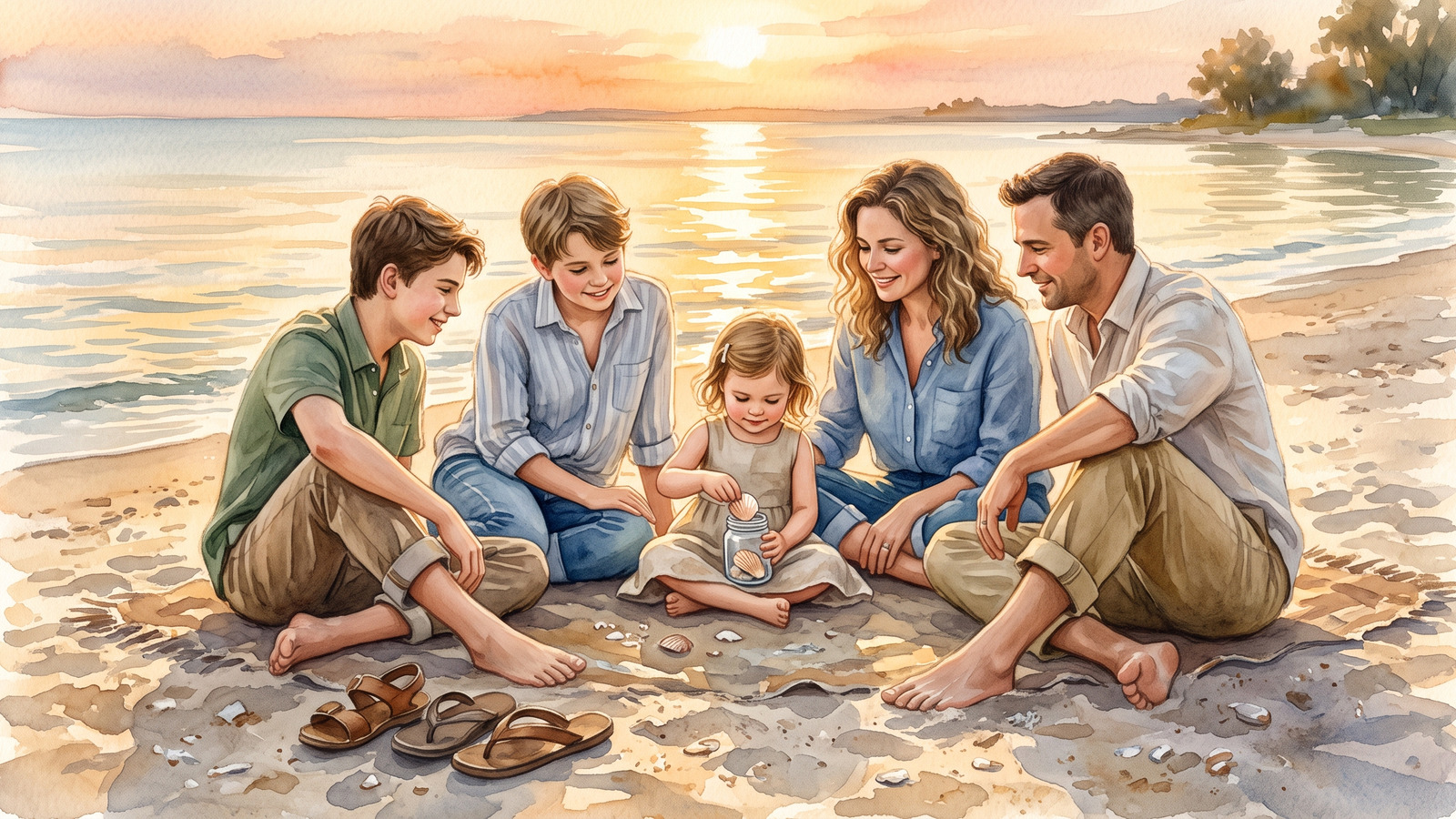
Some families leave church with the windows down and drive straight to the sand, still in their good clothes, for brunch from a cooler and an hour of doing gloriously little. Some families' whole Sunday service is the walk itself: the water, the kids ahead, the unhurried talk. Both kinds have discovered the same regional secret: this coast was built for sabbath, whatever shape yours takes. The gulf keeps the week's most reliable appointment (sunset, nightly, free), the sand absorbs children and worries with equal patience, and a family that shows up weekly with a little intention leaves with something the busy version of Sunday never delivers. This article is the gentle blueprint: the beach Sunday, its small traditions, and the gratitude habit that turns a nice view into a family's keel.
The rituals, small on purpose
| The ritual | How it runs | The age notes |
|---|---|---|
| Three-thanks circle | Each person, three thanks, before the snacks open | Littles may repeat "dolphins" forever: allowed |
| The thankful walk | Thanks said only for things seen on the walk | Turns noticing into thanking |
| The shell jar | One shell per Sunday, reason written on the slip | The memory-keeper's gratitude wing |
| The blessing or verse | For families who keep one: short, standing, spoken to the water | The same one every week wears in like a path |
| The sunset send-off | Week named and released, one hope spoken | The green-flash watch does double duty |
| The quiet minute | Sixty seconds, everyone silent, waves audible | Harder and better than it sounds |
The design principle across all six: brief, spoken, specific. Children metabolize gratitude through concrete nouns ("the pelican that almost landed on Dad") and choke on abstractions ("our many blessings"): the walk and the jar work because the thanks attach to things with sand on them. And brevity is protective: a ritual that takes ninety seconds survives decades; one that takes twenty minutes survives until the first cold snap.
For families of faith, and families of none
This site serves both, warmly, and the beach Sunday is where the two versions stand closest together. The faith-anchored edition has deep regional roots (this coast's churches empty toward the water every Sunday noon: the after-service beach brunch is practically a local liturgy), and the additions are simple: the standing verse spoken at the water, grace over the cooler, the creation-appreciating frame that makes every wonder article on this site read like a psalm to the families who hear it that way. The secular edition keeps identical bones: rest taken seriously, thanks said aloud, the week rhythmed around something bigger than the calendar: awe, the researchers would call it, and the gulf deals it nightly. The two editions can even share a beach blanket: gratitude spoken to God and gratitude spoken to the sunset sit side by side at the same quiet spot without friction. What both need is the same discipline: the slow-living protection of the day itself: a beach Sunday that has to out-compete travel ball and errands will lose; one that's simply what the family does, wins.
When the Sunday holds weight
A gentle word for the weeks when gratitude feels like heavy lifting: the tradition earns its keep precisely then. The circle bends without breaking (the honest "I'm having trouble this week: someone lend me one of theirs" models more than a fluent list ever could), the walk works wordlessly when talking won't come, and the water does what it has always done for grieving and worried people: stays large, stays moving, stays there. Families who kept the beach Sunday through a hard season report it became the season's spine: the one appointment that didn't require anyone to be okay, only present. Build the tradition in the sunny months: it's the sunny-month version that will hold you later.
The Little Naturalist activity
Start the gratitude jar properly: a clear jar, a Sunday shell, and a slip of paper with the date and the week's best specific thanks, written by rotating hands (pre-writers dictate). Rules: one shell only (shelling ethics apply even to gratitude), the reason must name something that actually happened, and the jar lives where breakfast happens. Twice a year: New Year's and the season's-end beach day: the family reads the jar aloud, oldest slip first. The reading takes eleven minutes and is, by every account of every family that keeps one, the best eleven minutes on the calendar: a year of Sundays, returned with interest.
Questions families ask
Our kids roll their eyes at the gratitude circle. Push through?
Keep it brief, keep it modeled, and let the eye-roll ride: teens perform immunity to rituals they privately bank (ask any adult what they remember of childhood Sundays and watch the eye-roller's list). The lend-me-one move and the walk version give resistant ages lower-friction doors: participation over performance, always.
We can't do weekly. Does monthly count?
The rhythm matters more than the frequency: a protected monthly beach Sunday outperforms an abandoned weekly one, and seasons of life resize the tradition honestly. The jar doesn't judge gaps: it just keeps the slips.
How does this fit with an actual church schedule?
No choreography required: the classic regional pattern is service, then sand: the brunch cooler packed the night before, good clothes traded in the parking lot, the sunset send-off closing what the morning opened. Families report the pairing deepens both halves: the pew and the shoreline turn out to be old colleagues.
Is there a version for the solo parent stretched thin?
The smallest one is the strongest: one parent, kids, a bag of oranges, the walk, the circle, home by noon. The tradition asks for presence, not production: and the solo-parent beach Sunday, kept simply, is the exact memory the kids will one day drive home to recreate.
Questions families ask
What is a beach Sunday?
A weekly-ish family tradition that treats one slow coastal outing as the week's anchor of rest and gratitude: a morning or evening at the water at half speed, with one or two small rituals attached: the thankful walk, a shared verse or blessing for families who keep one, the sunset send-off. Less an event than a rhythm.
How do families practice gratitude with young kids?
Concretely and briefly: the three-thanks circle (each person names three, littles allowed to repeat 'dolphins' weekly), the thankful walk where thanks are said for things actually seen, and the gratitude jar of shells, one per week with the reason written down. Abstract gratitude bounces off children; specific gratitude sticks.
Do beach Sunday traditions have to be religious?
No: the shape holds for every family. Households of faith often anchor it with a verse, a prayer, or the after-church beach brunch; others keep the same walk, thanks, and rest entirely secular. The coast doesn't check affiliation: the rhythm of rest and thanks is the shared inheritance.
Why do gratitude rituals matter for kids?
Practiced gratitude is one of the most consistently supported wellbeing habits in the family playbook: kids who regularly name what they're thankful for show measurably steadier moods and richer noticing. The beach version works because it ties thanks to real, seen things: sunsets photograph poorly compared to how they land in a child who was taught to say so.
Sources
More from the Bae
 Live WellCornerstone
Slow Coastal Living with Kids: The Family Rhythm That Beats the Rush
Slow coastal living with kids: the porch-morning, half-speed family rhythm that beats the rush, and how Tampa Bay makes it easier than anywhere.
 Explore
Sunrise or Sunset? The Best Beach Hours for Families, and the Photos to Prove It
Sunrise vs sunset on Tampa Bay's beaches: why the gulf owns the evening show, why families should steal the morning, and the photo tricks for both.
 Protect
Beach Cleanups with Kids: Where to Join One and How to Start Your Own
Beach cleanups with kids around Tampa Bay: Keep Pinellas Beautiful events, September's International Coastal Cleanup, and the DIY family kit.