
Roseate Spoonbills: Florida's Pink Surprise and Where to Find One This Week
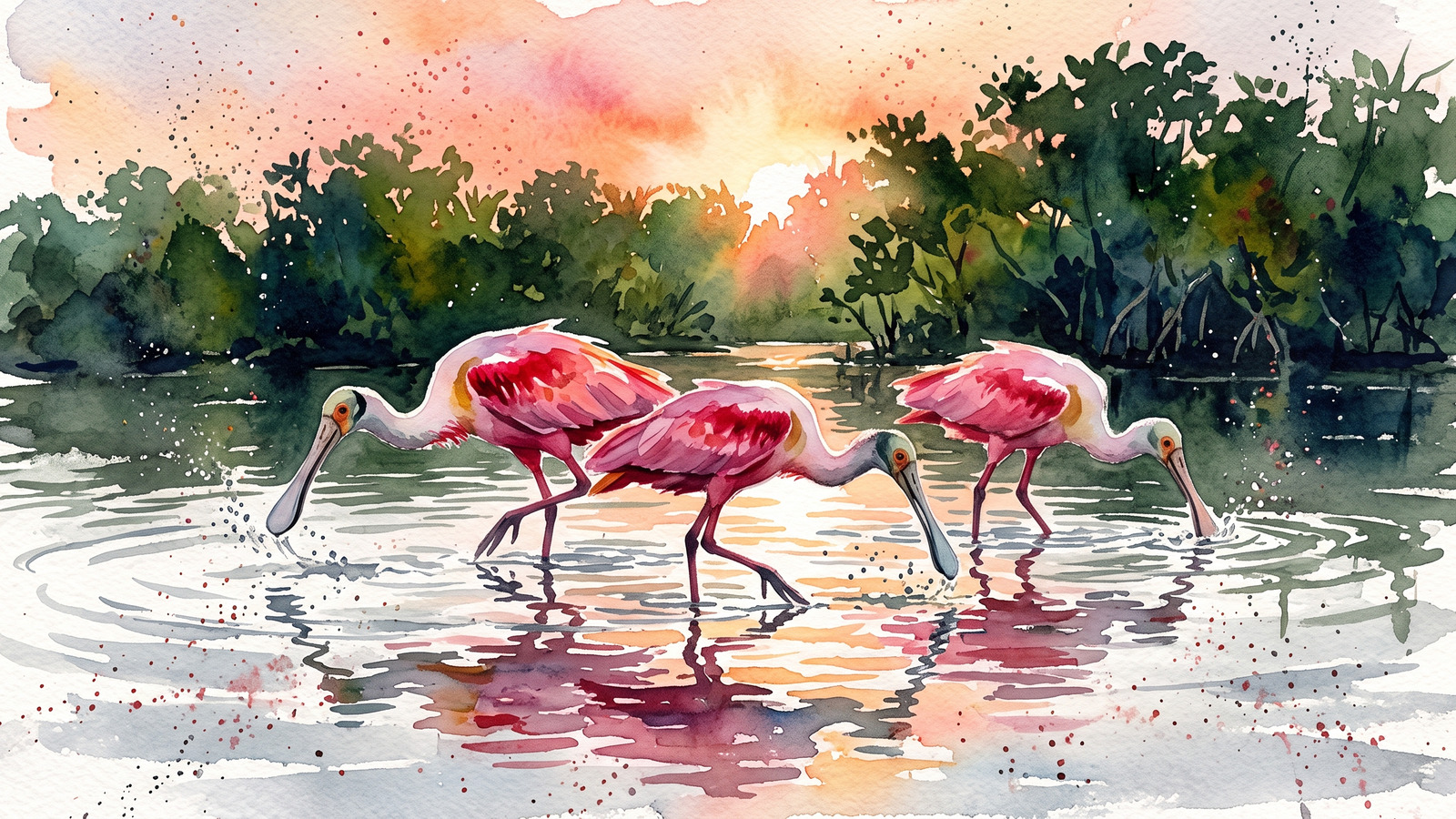
"FLAMINGO!" The shout goes up from the back seat somewhere along the Gandy, and a whole carful of necks swivels toward a pink shape stilting through the shallows. It's the most common wonderful mistake in Tampa Bay, and correcting it makes everyone happier, because the true answer is stranger: that's a roseate spoonbill, a bird that eats its way to pink, feeds by feel with a kitchen utensil for a face, and nearly went extinct over ladies' hats.
The spoon is not decorative
Watch a feeding spoonbill for one minute and the name explains itself: the bird wades slowly, bill underwater, sweeping its head in wide arcs like someone stirring an enormous pot. The flattened spoon tip is packed with touch sensors, and the instant a shrimp or small fish brushes it, the bill snaps shut. No looking required, which is why spoonbills can feed in murky water and even at night. Kids can mimic the motion with a wooden spoon in a bathtub, and afterward they will never call it a flamingo again.
The pink comes from the menu. Carotenoid pigments in the crustaceans they sieve accumulate in growing feathers, deepening from pale rose in young birds to shocking magenta shoulders in prime adults. Field biologists can roughly age a spoonbill by its blush, and now your kids can too.
Spoonbill or flamingo: the ten-second ID
| Field mark | Roseate spoonbill | American flamingo |
|---|---|---|
| Bill | Long, straight, flattened spoon at the tip | Short, thick, sharply bent |
| Head | Pale greenish and bare in adults | Feathered pink |
| Neck | Medium, held in a lazy curve | Extravagantly long, often an S |
| How it feeds | Sweeps side to side in shallows | Upside-down bill, stomping in place |
| Around Tampa Bay | Resident, seen weekly | Rare visitor, front-page news |
If the flamingo situation seems newly complicated, it is: wild flamingos have been returning to Florida in small numbers, and the Legislature has been debating the state bird crown itself. Your family is birdwatching inside a live civics story.
The hat that almost ended them
Here's the history worth telling at the trailhead. In the late 1800s, fashion demanded plumes, and Florida's wading bird rookeries were shot out by the boatload; spoonbill wings were even sold as fans. By the early 1900s, spoonbills had all but disappeared from Florida. The backlash, led in large part by women who refused the hats and organized the first Audubon societies, produced some of America's earliest wildlife protection laws and, eventually, protected island rookeries like the ones dotting Tampa Bay today, where spoonbills once again raise their chalky-white, gradually-pinking chicks.
So the pink bird on the flat is a survivor twice over: of the plume trade a century ago, and of habitat loss since. The Tampa Bay Estuary Program counts healthy wading bird rookeries among the signs our bay's recovery is holding, which makes every sighting a small progress report.
Where to find one this week
Low tide is the appointment: spoonbills need shallow water to sweep. Around Tampa Bay, the dependable stages are the mangrove lagoons along the Weedon Island Preserve boardwalks, Fort De Soto's north beach lagoon (scan it from the multi-use trail bridge), the wetlands at Circle B Bar Reserve on a Lakeland day trip, and, honestly, any roadside flat off the Gandy or the Courtney Campbell when the tide drains it. Morning and late-afternoon light turns the pink incandescent, which is when the photographers you'll see kneeling in the mud already know to come.
The Little Naturalist activity
Run a pink census. Over a month of outings, have kids log every pink bird: location, tide, and a one-to-five blush score, then chart whether deeper-pink birds cluster at certain spots. They're replicating real ornithology (diet quality mapping), and the family fridge gains a data visualization with actual field hours behind it. Fold the results into your birding starter list when that adventure begins.
Questions families ask
What time of year are spoonbills easiest to see?
They're here all year, with post-breeding gatherings in late summer and fall often producing the biggest flocks on the flats. Any low tide with soft light is a fair appointment in every season.
Do spoonbills nest near people?
They nest in island rookeries with other wading birds, several protected within Tampa Bay itself, which is why boaters see "bird island, do not land" signage. The no-landing rule is the whole nursery's security system; teach it early to your boating kids.
Why do I sometimes see a spoonbill sky-high in a dead tree?
Loafing and safety. Between feeding tides, spoonbills roost in mangroves and snags, looking gloriously wrong up there, like a flamingo sent to fill in for a heron. Scan treetops near any flat where you've seen them feed.
Are they related to ibises?
Closely: spoonbills and ibises share a family, and you'll often see them feeding together, the white ibis probing with its curved needle while the spoonbill sweeps its spoon. One flat, two utensils, which is a dinner-table metaphor your kids can run with.
Questions families ask
Is the pink bird I saw in Tampa Bay a flamingo?
Almost certainly a roseate spoonbill. Spoonbills live and nest around Tampa Bay year-round, while wild flamingos remain rare visitors mostly further south. The giveaway is the bill: a spoonbill's is long and flattened like a wooden spoon; a flamingo's is short and sharply bent.
Why are roseate spoonbills pink?
Their food colors them. Spoonbills eat small crustaceans and other invertebrates rich in carotenoid pigments, the same chemistry that pinks flamingos and turns shrimp orange in the pan. Young spoonbills start pale and blush deeper with every year of good eating.
Where can my family see a spoonbill near Tampa Bay?
The boardwalk lagoons at Weedon Island Preserve, the north beach lagoon at Fort De Soto, and the wetlands at Circle B Bar Reserve near Lakeland are the reliable spots. Go at low tide in soft morning or late-afternoon light and scan the shallow flats.
Were spoonbills really almost wiped out?
Yes. In the late 1800s plume hunters shot wading birds by the tens of thousands to decorate hats, and spoonbills nearly vanished from Florida. The outrage over that trade helped launch the Audubon movement and some of America's first bird protection laws. Every spoonbill you see is a recovery in progress.
Sources
More from the Bae
 LearnCornerstone
Florida's State Symbols, Explained for Kids: Every Animal, Flower, and Song, and the Stories Behind Them
Every Florida state symbol explained for kids: the panther, manatee, mockingbird, zebra longwing, and more, with the stories and the flamingo debate.
 Learn
LearnWhy Is Our State Bird a Mockingbird? The Flamingo Question, Answered for Curious Kids
Florida's state bird is still the mockingbird, but a 2026 bill would crown the flamingo and name the scrub-jay songbird. The debate, for kids.
 Learn
LearnSea Turtle Season: The Family Beach Rules That Save Nests from May to October
Sea turtle nesting season runs May through October on Tampa Bay beaches. The family rules: fill holes, flatten castles, lights out, and let nests be.