The Mangrove Nursery: Why Florida's Tangled Trees Matter More Than They Look
No child has ever looked at a mangrove and been neutral. The trees stand in the water on arched stilts, like something mid-stride that froze when you turned around; their roots host upside-down cities of oysters and crabs; their seeds are little green javelins that sprout while still hanging from the branch, then drop and float away to found colonies. Adults drive past ten thousand mangroves a year and see green blur. Kids see immediately what science eventually confirms: these trees are up to something, and it turns out the something is holding the entire coast together.
Three trees, three jobs, one line each
Teach the lineup the way locals learn it: red walks, black breathes, white stays dry.
The red mangrove is the icon: arching prop roots straddling the waterline, the "walking tree" your kids will identify forever after one sighting. It's the pioneer, standing furthest into the salt, and its roots are the nursery ward. The black mangrove grows a step landward and solves the airless-mud problem differently: hundreds of pencil-thin breathing tubes (pneumatophores, the second-best vocabulary word in this series after spat) poke up from the mud around it like a bed of snorkels, and its leaves often glitter with excreted salt crystals kids can (lightly) taste-test with a fingertip touch. The white mangrove takes the high ground, plain-leaved and modest, completing the gradient. Line all three up along one shoreline and your children have read an entire ecosystem's seating chart.
| The species | The tell | The trick |
|---|---|---|
| Red mangrove | Arching stilt roots in the water | Sprouts javelin seedlings (propagules) that float away to colonize |
| Black mangrove | Snorkel field of breathing tubes | Excretes salt onto its leaves; look for crystals |
| White mangrove | Higher, drier, oval leaves | Sweats salt through leaf glands; subtlest of the three |
The nursery behind the tangle
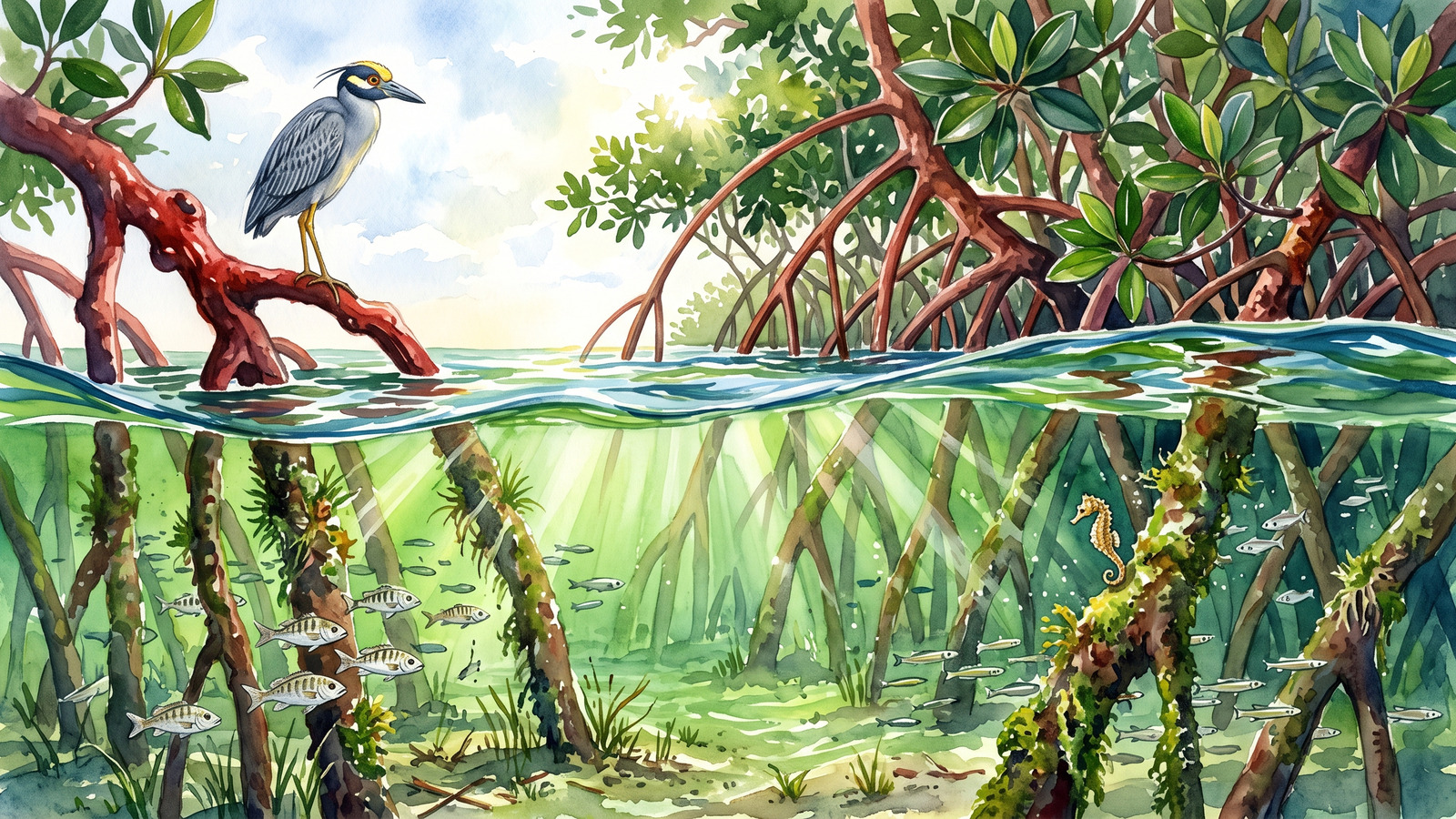
Put a mask underwater beside red mangrove roots (or just peer down from a Weedon boardwalk at low tide) and the tangle resolves into infrastructure: oysters and barnacles crusting the roots and filtering away, crabs patrolling, and everywhere the glitter of juvenile fish: baby snapper, snook, sheepshead, and mullet using the root maze exactly as a nursery: too tight for big predators, endless food, shade overhead. Like the seagrass meadows they partner with, mangrove fringes raise a huge share of the bay's future catch: the snook your family admires at the pier almost certainly spent its childhood inside one of these tangles. Wading birds run the canopy as a rookery (whole islands of Tampa Bay mangroves are protected nesting colonies), and the fallen-leaf tea the trees steep into the water (that tannin stain, like weak iced tea) feeds the food web's smallest floor.
The seawall that grows back
Here's the job that turned mangroves from scenery into law: wave defense. A healthy mangrove fringe shreds wave energy in its roots and trunks, knocking down storm surge's punch and holding sediment that open shoreline surrenders: engineers now measure it, insurers now price it, and the state's building code of the coast now leans on it, with living shorelines (mangrove plus oyster plus marsh) replacing bare seawalls project by project. The bay's hard lesson is exactly this in reverse: the mid-century decades that bulldozed mangrove fringe for waterfront lots traded a self-repairing seawall for an eroding one, and a nursery for a bare edge.
Which is why the law has teeth: Florida's Mangrove Trimming and Preservation Act makes cutting or removing mangroves without following its rules illegal (limited homeowner trimming is allowed within specified heights and methods; larger work needs professionals and permits), and violations bring real fines plus mitigation. The kid translation: these trees have lawyers now, and the reasons are the two sections above.
Where to meet them, canopy-level
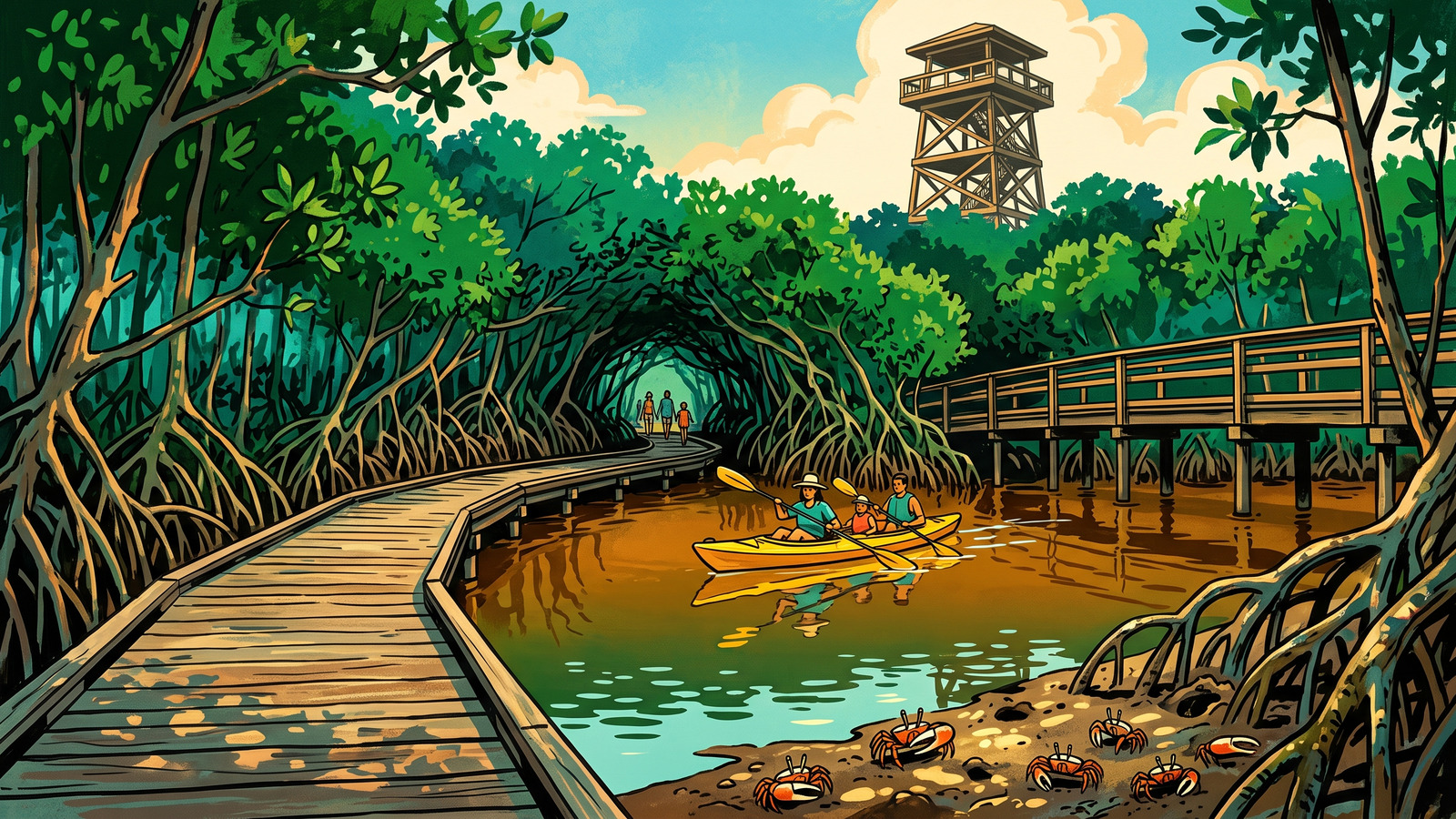
The region's mangrove access is genuinely excellent: Weedon Island's boardwalks thread all three species with signage, low tide turning the black mangrove snorkel-fields into full display; Fort De Soto's edges and Anclote's shorelines add variety; and the crown experience is the kayak tunnel, where the canopy closes overhead and even loud children go quiet. Timing note for comfort: winter and breezy days beat still August afternoons in mangrove country, for reasons your family will discover exactly once without bug spray.
The Little Naturalist activity
The propagule regatta: in late summer and fall, red mangrove seedlings (those green javelins) drop and drift ashore along bay beaches: legitimately collectible from the wrack in reason. Have kids float a few in a bucket and observe the design (they bob upright, root-end down, pre-sprouted and ready to plant themselves), then release them along the same shoreline's waterline to continue the voyage. It's a naval architecture lesson taught by a tree, and returning the sailors to duty is the leave-it-better rule with a launch ceremony.
Questions families ask
Are mangroves endangered here?
Protected rather than endangered: Florida holds hundreds of thousands of mangrove acres statewide, but historic losses around developed bays like ours were severe, which is why the law guards every fringe and restoration projects replant them along living shorelines. Around Tampa Bay, every surviving stand is doing outsized work.
Why do mangroves smell like sulfur sometimes?
That low-tide whiff is the mud itself: oxygen-poor sediment where bacteria work sulfur chemistry, the exact airless muck the trees evolved their snorkels and stilts to beat. Reframe it for kids as the smell of a system working: rich mud means a fed food web, and the breathing tubes make sudden sense.
Can we plant mangroves in our own shoreline?
Waterfront families should ask before acting: restoration planting is real and encouraged through permitted programs, but shoreline work touches state rules quickly. The right first call is a local extension office or a group like Tampa Bay Watch, which runs organized plantings your kids can join with shovels supplied.
What lives in mangroves that we should watch for?
Mostly delight: mangrove tree crabs skittering up trunks, herons at eye level, jumping mullet, the occasional raccoon commuting. Standard Florida sense applies at the water's edge (gator awareness in brackish reaches, sturdy shoes on oyster-crusted ground), and the reward for looking closely is the region's densest wildlife per square yard.
Questions families ask
What's so special about mangroves?
They're the only trees that thrive with their feet in salt water, and they do three enormous jobs at once: nursery (their underwater roots shelter baby fish, crabs, and shrimp), seawall (they blunt waves and storm surge), and filter (they trap sediment and hold shorelines together). Losing them is why parts of the bay eroded; keeping them is law.
How do you tell Florida's three mangroves apart?
Red mangroves stand on arching prop roots at the water's edge, like trees walking on stilts. Black mangroves grow a lawn of pencil-like breathing tubes (pneumatophores) around their trunks and often wear salt crystals on their leaves. White mangroves keep to higher ground with plain oval leaves. Red walks, black breathes, white stays dry.
Is it really illegal to cut mangroves in Florida?
Cutting or removing them without following the state's Mangrove Trimming and Preservation Act is illegal, with real fines. Waterfront owners can do limited trimming within the rules (heights and methods are specified, and bigger jobs require professionals or permits), but clearing mangroves is a serious violation.
Where can families walk through mangroves near Tampa Bay?
The boardwalks at Weedon Island Preserve run right through all three species, Fort De Soto's trails skirt mangrove edges, and the kayak tunnels at Weedon and along the coast put you inside the canopy. It's the region's most accessible rainforest-feeling habitat.
Sources
More from the Bae
 Learn
LearnA Family Guide to Weedon Island: Boardwalks, Herons, and a Thousand Years of History
Weedon Island Preserve packs boardwalks, an observation tower, mangrove paddling, and a thousand years of Tocobaga history into one free St. Pete morning.
 ProtectCornerstone
The Tampa Bay Comeback: How Our Bay Nearly Died and Came Back to Life
By the 1970s Tampa Bay was nearly dead: algae mats, empty water, vanished birds. How laws, science, and neighbors brought it back, told for families.
 Protect
Seagrass, Explained for Kids: The Underwater Meadows Everything Depends On
Seagrass is the underwater meadow feeding Tampa Bay: nursery for most of our fish, manatee salad, and oxygen factory. The kid-level tour.