
Lights Out for Turtles: How Beach Towns Go Dark for Nesting Season, and Families Can Too
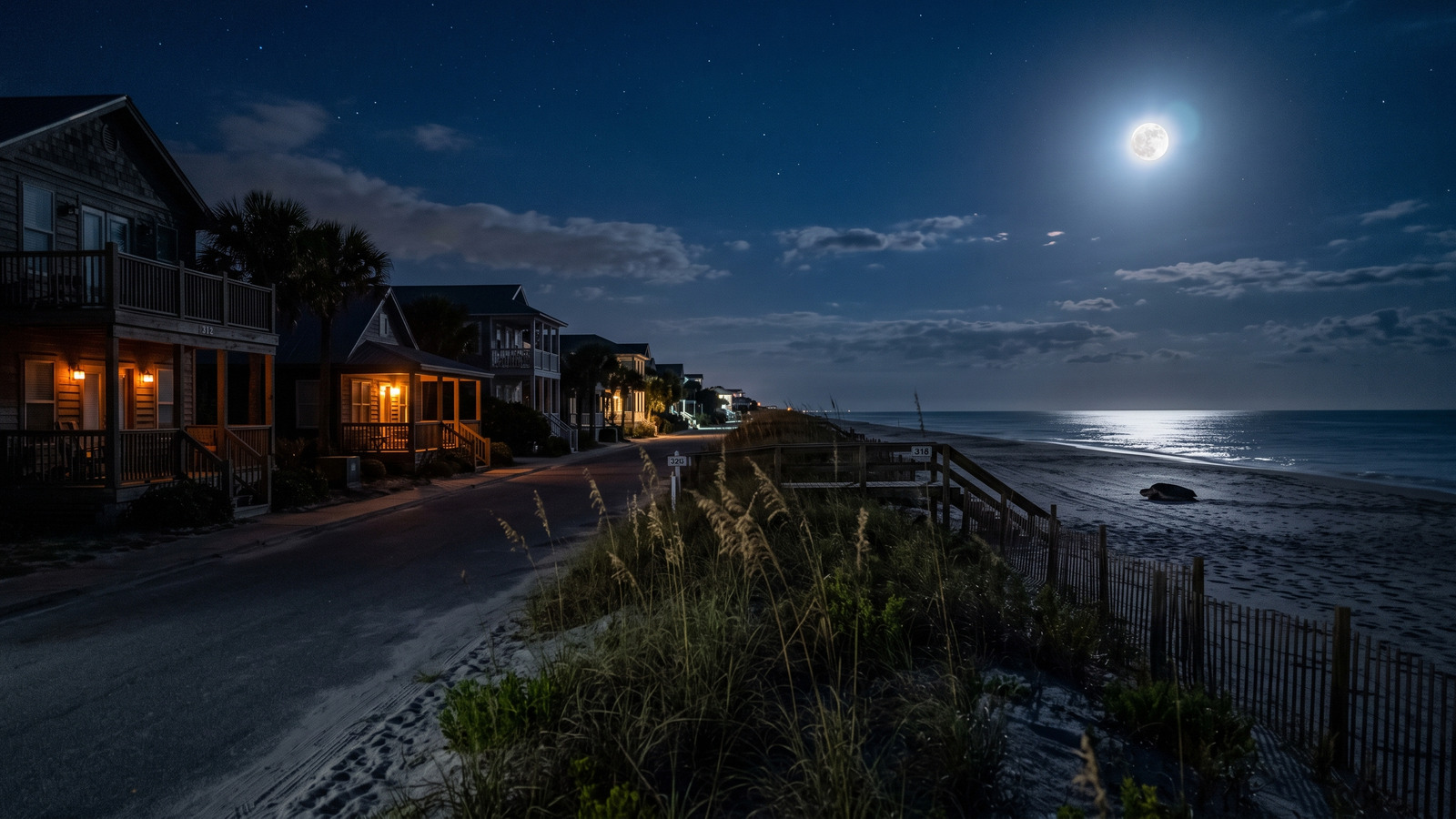
Stand on a gulf beach at ten on a summer night and let your eyes adjust. The show that emerges (moonlight laying a silver road across the water, stars in real numbers) is not just the region's best free planetarium. It's a navigation system, four hundred million years older than the porch light, and every summer, somewhere under the sand behind you, a hundred small navigators are waiting to use it. Whether they make it to the water or die in a parking lot can genuinely come down to whose blinds are open. This is the story of why the beach goes dark, and how your family joins the darkness like locals.
The compass in a hatchling's head
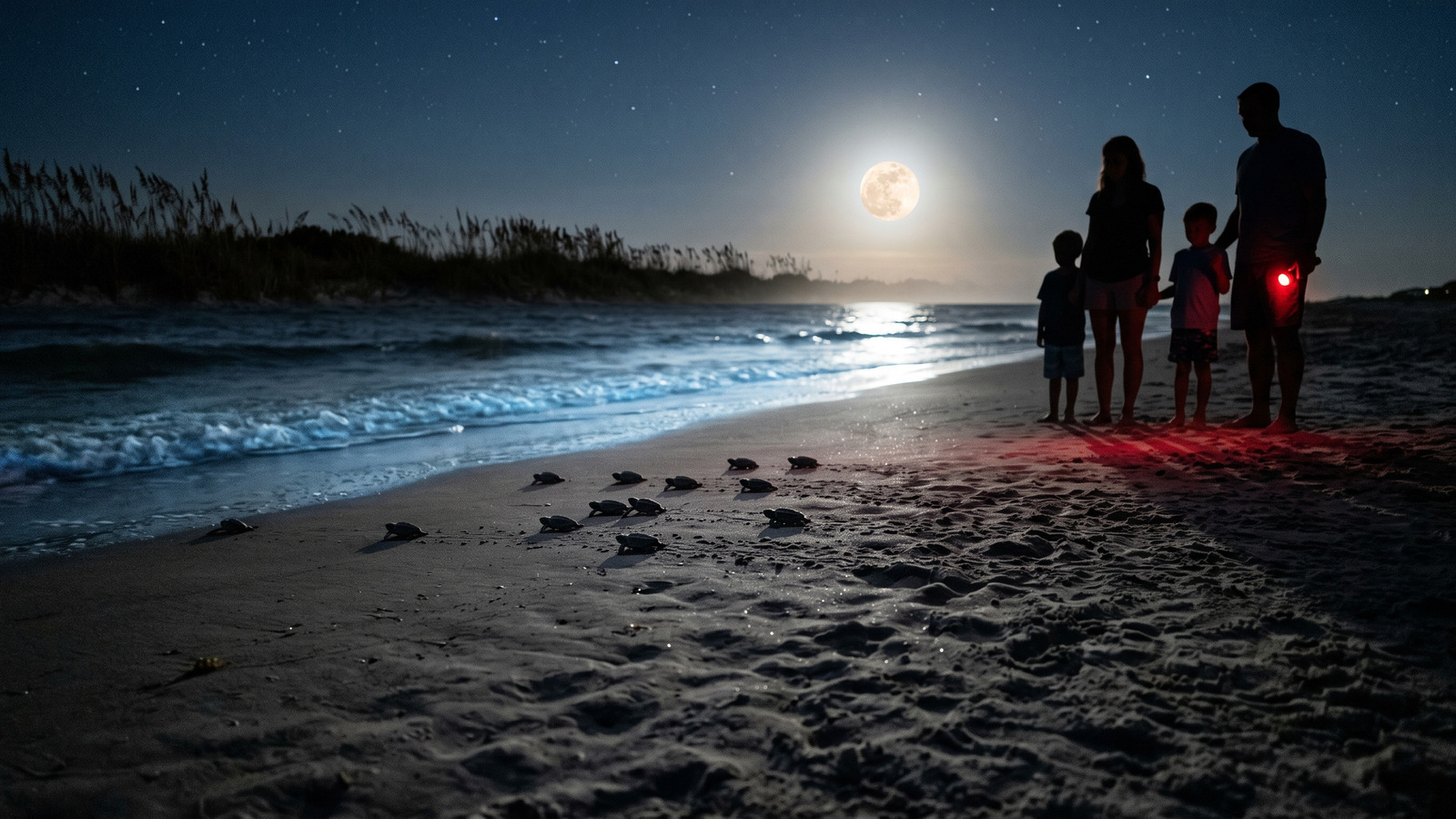
The mechanism is elegant enough for a bedtime story. A hatchling erupts from the sand at night with one instruction: go toward the bright, low horizon. For all of turtle history, that was the ocean, luminous with reflected moon and stars while dunes and vegetation stood dark behind. The nest your family walked past in July runs this program in August: a hundred hatchlings, surfacing together, sprinting their compass heading. Every one that reads the horizon right reaches the surf and swims its frenzy offshore. Every one that locks onto a streetlight, a glowing pool deck, or a bright condo window runs inland instead, and inland is roads, storm drains, ghost crabs, and sunrise. Patrols call it disorientation, they document it every season up and down the coast, and the cause traced is so often a single visible light source.
The mother's version matters too: nesting females avoid brightly lit beaches, abandoning approaches (false crawls) when the shore reads wrong. Dark beaches recruit more nests in the first place.
Low, shielded, long: the whole code in three words
FWC's wildlife lighting standard compresses to a phrase kids can chant, and it's worth unpacking each word once:
| The word | What it means | The kid version |
|---|---|---|
| Low | Mount fixtures low; use only needed brightness | Light the path, not the sky |
| Shielded | Aim down; bulb never visible from the beach | If a turtle can see the bulb, it's wrong |
| Long | Long wavelengths: amber, orange, red | Turtle eyes barely register amber; white and blue scream |
That third word explains the amber streetlights and red-tinted fixtures your kids have noticed in beach towns: turtle-friendly lighting isn't dimness for its own sake, it's color science, since turtle vision is most sensitive to short (white/blue) wavelengths and barely registers long ones. FWC maintains a certified wildlife lighting program, and coastal ordinances from Anna Maria to Clearwater are built on the framework, active May 1 through October 31.
The renter's five-minute compliance kit
Beachfront homeowners handle fixtures; the rest of us handle habits, and visitor lighting is a real share of the problem. The whole kit: after 9 p.m., close blinds and drapes on gulf-facing windows (interior light spills further than anyone believes), turn off balcony and porch lights entirely, and walk the night beach by moonlight (the point, after all) with white flashlights and phone lights off: a red-filter mode or red headlamp if footing demands it, angled down, never at the water, never at a staked nest. Flash photography on the night beach is out for the season, full stop. If your rental's exterior lights blaze all night on a timer you can't control, mention it to the manager: properties get friendly official letters about exactly this, and yours won't mind the heads-up.
Making darkness the family treat
Here's the reframe that makes compliance feel like privilege: lights-out season is stargazing season. The same darkness that guides hatchlings hands your family the Milky Way over the gulf, meteor showers in August (the Perseids land mid-season, a scheduling gift), and the night-beach worlds of ghost crabs and bioluminescent sparkle in the wavewash. A family that spends one blanket hour on a dark beach stops experiencing the ordinance as restriction forever: the dark is the amenity, and the turtles are just the reason the county protects it.
The Little Naturalist activity
Run the hatchling's-eye audit: at 9:30 on a summer night, walk your beachfront block (or your rental's stretch) and have kids crouch to ankle height, scanning the landward horizon exactly as a hatchling would: what's the brightest thing visible? Log each offender (bare bulb, glowing window, pool light) and grade the beach. Then fix your own contributions on the spot and watch the grade change. It's a real survey method (lighting inspectors do essentially this), and children who have seen the beach as a hatchling sees it become lifelong enforcement.
Questions families ask
Do the rules apply away from the beachfront?
The ordinances bind coastal properties, but light travels: skyglow from blocks inland brightens the beach horizon too, which is why beach towns push shielding community-wide. The family habit version: your porch light aims down wherever you live, and the whole coast breathes easier.
What do we do if we actually see disoriented hatchlings?
Don't herd them with a flashlight (even helpfully aimed: it compounds the confusion). Kill nearby lights you control, and call FWC's Wildlife Alert line, 888-404-3922, which handles exactly this. The patrol network's responders are permitted and practiced; your family's job is the phone call and the dark.
Is moonless-night nesting a problem, if there's no moon to follow?
Beautifully, no: even moonless, the seaward horizon out-glows the dark dune line by starlight alone, and the compass reads fine, provided we haven't lit the landward side. The system needs no moon; it needs contrast, which is precisely what the ordinances protect.
Are the amber streetlights safe for people?
Fully: amber LED streetlighting meets roadway standards and, as a bonus, many people find it gentler on night vision and sleep. The turtle-friendly beach town is, accidentally, also the best-lit-for-humans beach town: one more case where what protects the coast improves the neighborhood.
Questions families ask
Why do Florida beach towns turn lights off in summer?
Because sea turtle hatchlings find the ocean by crawling toward the brightest horizon, which for millions of years meant moon and stars on water. Artificial light behind the beach reverses their compass, sending them inland toward roads and pools. Local lighting ordinances run the length of nesting season, May 1 through October 31.
What are the rules for lights near nesting beaches?
FWC teaches three words: keep it low (mounted low, only as bright as needed), keep it shielded (aimed down, source not visible from the beach), and keep it long (long-wavelength amber or red light, which turtles barely perceive). Beachfront properties follow local ordinances built on exactly those principles.
We're just renting for a week. What should we do?
Close blinds and drapes after 9 p.m. so interior light doesn't spill seaward, turn off balcony and porch lights, and skip white flashlights and phone lights on the night beach (a red-filtered light if you must walk). Renters cause a surprising share of disorientations, and the fix costs nothing.
Does one porch light really matter?
One light can misdirect an entire nest: a hundred hatchlings following the brightest point. Disorientation events get documented every season, and investigators regularly trace them to a single fixture. It's one of the rare conservation problems where one family flipping one switch is literally the solution.
Sources
More from the Bae
 Learn
LearnSea Turtle Season: The Family Beach Rules That Save Nests from May to October
Sea turtle nesting season runs May through October on Tampa Bay beaches. The family rules: fill holes, flatten castles, lights out, and let nests be.
 Protect
Why We Fill In Our Sandcastle Holes: Small Beach Habits That Save Turtles (and Rescuers)
Beach holes trap sea turtles, block rescuers, and collapse on diggers: why filling in holes is the beach's most important habit, and how to dig safely.
 Learn
LearnBaby Shorebirds on Our Beaches: What the Roped-Off Areas Protect, and How to Teach the Why
Those roped-off beach areas protect eggs and chicks you can't see: skimmers, terns, and plovers nesting February 15 to August 31 on Tampa Bay sand.