
Beach Days Without the Meltdown: The Packing List Tested by Real Families
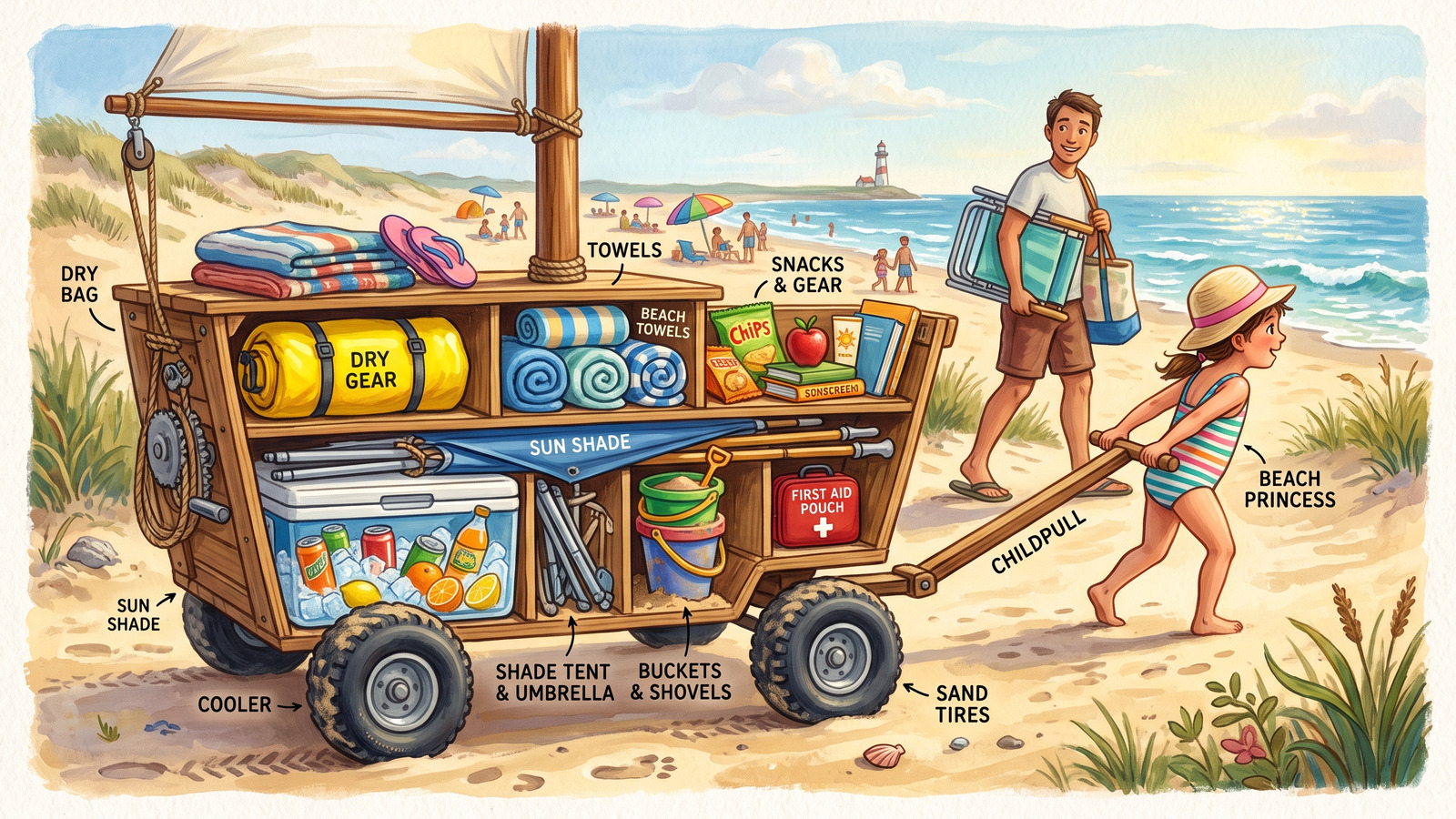
Every beach parking lot at 2 p.m. hosts the same opera: a small person face-down on a towel singing the song of their people, a parent doing the forearm math on wet sand versus car seats, and somewhere under the umbrella, the empty water jug that explains everything. None of it was bad luck. Beach meltdowns are engineering failures, not character ones, and the engineering is beatable with one bag, three rules of thumb, and an exit ritual smart families run while everyone's still happy. Here is the system, field-tested by the region's veteran crews.
The always-bag: packed once, ready forever
The core insight of veteran beach families: the bag never fully unpacks. One tote (plus the cooler) holds the invariants, restocked on return rather than assembled at dawn:
| The core | The reasoning |
|---|---|
| Water: 1 liter / person / 2 hours (double in high summer) | The single highest-leverage item; freeze half the bottles |
| Owned shade: umbrella or beach tent + sand anchor | Rentals run out; the sun does not |
| Mineral sunscreen + a rash shirt per kid | The shirt is sunscreen you apply once |
| Snacks in hard containers | The sandbar doctrine: grapes, watermelon, nothing that regrets humidity |
| Water shoes, every crew member | Shell beds, hot sand, bay bottoms |
| The flat first-aid kit | Bandages, tweezers, antiseptic, vinegar packet (jelly brushes), motion tabs |
| Dry clothes + towel per kid, bagged | The ride home is the meltdown's last ambush |
| The fill-in shovel + bucket | Construction and its civic duties |
| Trash bag + zip bags | Pack-out, wet suits, phone armor |
| The red headlamps (in season) | Turtle-legal evenings |
Everything after that is genre: the flag kit and boogie boards for surf days, the bucket viewer for the flats, the egg-carton collection kit for shell missions, rods for pier detours. The always-bag means the decision at 8 a.m. is only ever which genre, never whether-we're-capable.
The three timers that beat biology
Meltdowns run on physiology, so the counters run on cllocks, not moods. The shade timer: every 45 minutes, everybody under the umbrella for ten: non-negotiable, framed as snack-and-scout, and it resets the heat math that kids can't feel until too late. The sunscreen timer: first coat at home (it needs fifteen minutes to bind anyway, and the naked-toddler-in-the-parking-lot application is nobody's finest hour), then reapply every 80 minutes by phone alarm: the rash shirts halve the surface area under dispute. The snack-before-the-ask timer: food appears on schedule, not on request, because the request arrives ten minutes after the blood sugar already left. Families running the three timers report the eerie experience of 3 p.m. arriving with everyone still pleasant: which is the entire product this article sells.
The exit ritual: leaving as a ceremony
The day's last fifteen minutes decide its memory, so the veterans script them. The sequence: the ten-minute warning delivered as a mission ("last swim, then treasure check"), the four-count sweep (holes flat, trash out, treasures checked, nothing living) run by the day's marshal, the rinse-and-dry-clothes conversion at the showers or the gallon-jug foot wash (a dedicated jug of tap water in the trunk: the cheapest luxury in Florida parenting), and the sealed ceremony: the drive-home treat that makes departure a destination: the Dunedin ice cream, the pier-shop popsicle, the sacred drive-through. Children who know the exit has its own rewards stop defending the beach like a fort at closing time: the opera in the parking lot was always about endings without a plot.
The car kit: the system's garage
The trunk carries the always-bag's supporting cast between trips: the foot-wash jug, a beach blanket that shakes clean, the sand-proof phone bags, two folding chairs, the spare towels that live there permanently, and (the veteran move) a complete change for the driver too, because the day somebody's wave misjudgment soaks the only adult is the day this list earns its keep. Restock ritual: bag and trunk refilled the evening of return, while the gaps are memorable: future-you, staring down a 7:40 a.m. departure, inherits a system instead of a scavenger hunt.
The Little Naturalist activity
Hand the packing over: kids build the day's genre kit themselves against the printed always-bag list, with a parent running only the final audit (water math and first aid stay grown-up-verified). Ownership converts the load-out from parental service into expedition prep, kids who packed the bucket viewer use the bucket viewer, and the day's inevitable gap ("we have no spoons") becomes their engineering lesson instead of your failure. By the third self-packed trip, your family has quartermasters: the boat-day crew system, landside.
Questions families ask
What about the baby-specific list?
Add: the pop-up shade with SPF fabric (babies get zero direct sun), a blanket-sized wet-wipe budget, the inflatable tub trick (a blow-up pool as sand-free base camp), and the calm-water venue choice doing most of the work. Babies at the right beach with owned shade are famously portable; babies at the wrong one famously aren't.
Do we really need water shoes at a sugar-sand beach?
The sand's fine until it's noon-hot or the bay bottom's shelly, which between them cover half of family beach hours. At two dollars a pair at season's end, they're the cheapest insurance in the bag: buy a size up and they serve two summers.
What's the single most-forgotten item?
The dry clothes, by a mile, followed by the phone chargers the sunset crew needed. The always-bag system exists precisely because memory fails on schedule: the list remembers so the 7 a.m. brain doesn't have to.
Umbrella or beach tent?
Umbrella for the two-hour trip and the packing-light family; tent for the toddler-era half-day with its nap-corner and gear garage. The real answer is whichever one you'll actually carry: shade owned but left home protects nobody, which is why the veterans' shade lives in the trunk year-round.
Questions families ask
What should families always pack for a Florida beach day?
The always-bag core: water (a liter per person per two hours), shade you own (umbrella or tent), mineral sunscreen plus rash shirts, snacks in hard containers, water shoes, the first-aid flat kit (bandages, tweezers, vinegar), dry clothes per kid, and the fill-in shovel. Everything else is genre-specific.
What's the best way to handle sunscreen with kids?
Apply the first coat at home (before clothes, before the car: it needs fifteen minutes anyway), reapply on a timer every 80 minutes or after every big swim, and let rash-guard shirts and the shade tent do half the job. The fights end when the shirt replaces the third full-body application.
How much water is enough at the beach?
The working math: one liter per person per two beach hours, doubled in July and August. Freeze half the bottles the night before: they're the cooler's ice until noon and cold water after. Running out of water is the number one preventable beach-day ender.
What causes most beach meltdowns, honestly?
Heat, hunger, and overtime, in that order: kids fry, crash, and get kept past their tank. The fixes are structural: shade and water on schedule, snacks before the ask, and a planned exit with its own ritual, run before the collapse instead of after.
Sources
More from the Bae
 ExploreCornerstone
The Family Beach Matchmaker: The Right Tampa Bay Beach for Toddlers, Shellers, and Wave Chasers
The right Tampa Bay beach for your family: calm water for toddlers, shelling sands, tide pools, waves, dogs, and sunsets, matched honestly.
 Protect
Why We Fill In Our Sandcastle Holes: Small Beach Habits That Save Turtles (and Rescuers)
Beach holes trap sea turtles, block rescuers, and collapse on diggers: why filling in holes is the beach's most important habit, and how to dig safely.
 Protect
Leave It Better: Teaching Kids the Leave No Trace Rules, Beach Edition
The seven Leave No Trace principles for Florida beach families: shells and sand dollars, dunes and sea oats, wildlife space, leaving it better.