
A Family Guide to Weedon Island: Boardwalks, Herons, and a Thousand Years of History
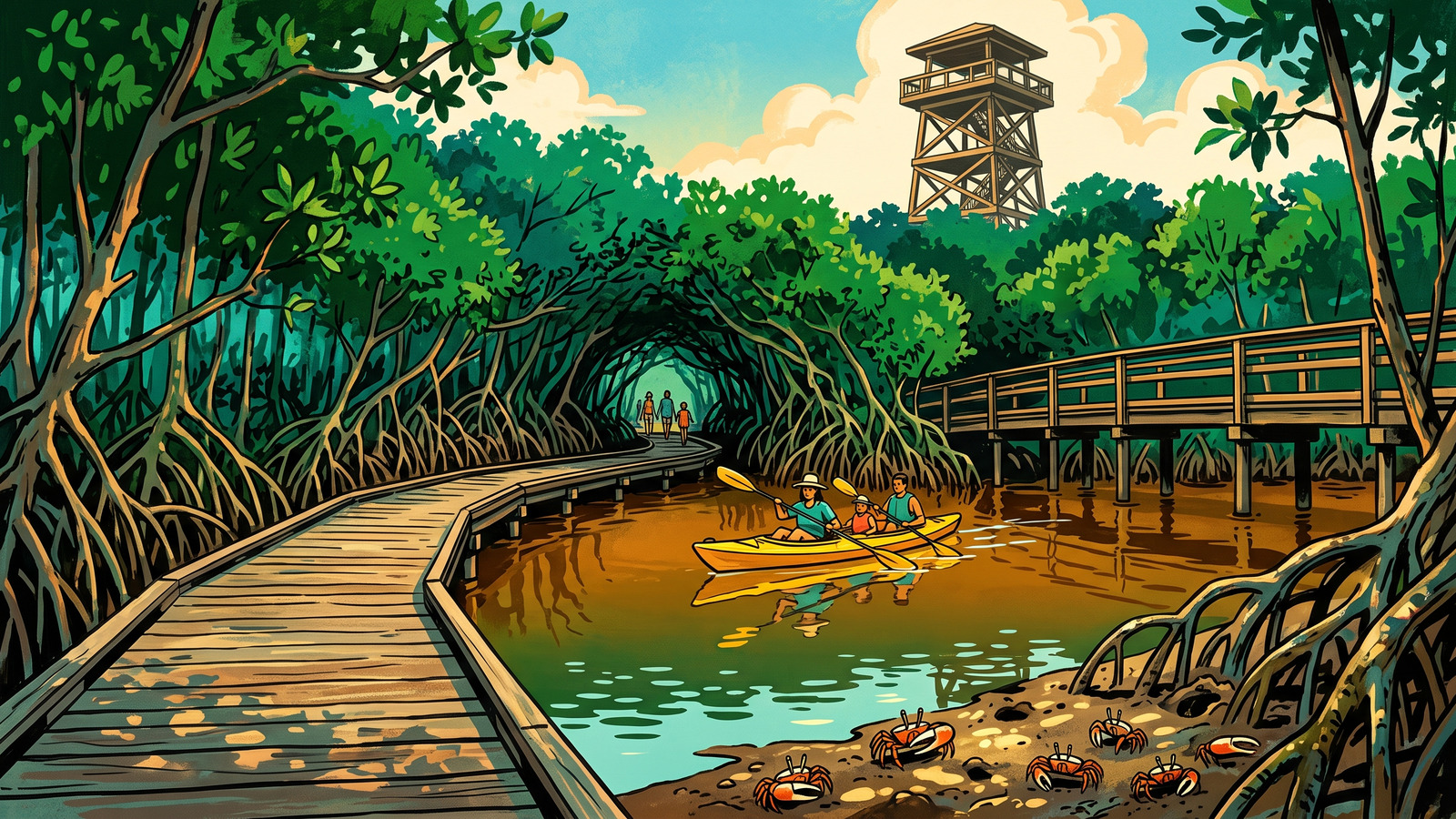
Ten minutes from the Gandy Bridge, past a power plant and a modest brown sign, the road narrows into mangroves and something changes in the car: the kids stop asking how long, because the water is suddenly on both sides and a heron just crossed the windshield like a slow gray kite. Weedon Island Preserve is 3,000-plus acres of old Florida parked inside the city limits of St. Petersburg, and it might be the highest-value free morning in Tampa Bay: birds at handshake range, a tower over the mangrove canopy, a real archaeology story, and paddling tunnels straight out of an adventure book.
The boardwalk and the tower
Start on the main boardwalk loop: flat, railed, and threading through mangrove flats where the tide breathes in and out twice a day. This is close-range bird country: ibis probing the mud below the rails, herons and egrets posing at distances that make binoculars optional, mullet flipping, fiddler crabs waving armies of one enormous claw at low tide. The boardwalk ends its best branch at the observation tower, 45 feet of stairs that lift you above the canopy to the whole geography lesson at once: mangrove islands, the open bay, downtown Tampa across the water, and, in season, spoonbill pink scattered across the flats like dropped bougainvillea.
Kid pacing advice from hard experience: the tower is the destination that keeps young legs moving, so promise it early, count the platforms on the climb, and budget the way back for every fiddler crab pool you rushed past on the way out.
The center: a thousand years in thirty minutes
The Cultural and Natural History Center near the entrance is free, air-conditioned (a fact worth its own sentence in August), and genuinely good: exhibits walk kids through the ecosystems they just saw and the people who lived here first. And here's the detail that elevates the field trip: when archaeologists excavated the mounds on this shoreline a century ago, the distinctive ceremonial pottery they found became the reference point for an entire pre-Columbian culture, now called the Weeden Island culture, whose influence spread across the Southeast. Your kids are standing at the type site, the place other discoveries get compared to. The later chapters (the Tocobaga towns that Spanish expeditions met, a story we tell fully in its own article) start on this same ground.
The center runs guided hikes and family programs on a regular calendar; check days and hours before you go, since the building keeps a shorter schedule than the preserve itself, which is open sunrise to sunset daily.
The paddling tunnels
For families with confident swimmers (life jackets non-negotiable, per the water rules), Weedon's marked South Paddling Trail is the region's classic first mangrove paddle: a few unhurried miles winding through tunnels where the canopy closes overhead, roots arch like flying buttresses, and the quiet is total except for herons startling ahead of the bow. The on-site outfitter rents kayaks and paddleboards seasonally; the trail is marked and shallow, mostly protected from wind and boat traffic. We'll walk the route turn-by-turn in the dedicated kayaking guide, but know this now: children who have paddled a mangrove tunnel describe it for years.
The visit, planned
| Detail | The honest answer |
|---|---|
| Cost | Free; kayak rental optional |
| Hours | Preserve daily, sunrise to sunset; center on a shorter schedule |
| Time needed | 90 minutes for boardwalk + tower; half a day with center and paddle |
| Best conditions | Morning low tide: cooler, birdier, crabbier |
| Stroller reality | Boardwalks yes; tower is stairs |
| Bring | Water, hats, bug spray in summer, closed toes for the trails |
| The pier | Fishing allowed; licenses per FWC rules |
The Little Naturalist activity
Assign the tide detective case: check the tide chart before arriving (the tides guide shows how), then have kids inventory one square of mudflat from the boardwalk at arrival and again before leaving: water level against a root, crab count, bird count. Two observations, an hour apart, and they've documented the bay breathing. It's the simplest field science on offer here and it reframes every future beach day: the water is always going somewhere, and now they know to ask where.
Questions families ask
Are there alligators at Weedon Island?
It's brackish mangrove country, so gators are uncommon visitors rather than residents; treat any pond edge with standard gator sense and enjoy the fact that the boardwalk rails make the question academic.
Can we swim or beach here?
No: Weedon is a preserve of flats and mangroves, not a swimming beach. The trade is fair; for sand and swimming, the beach matchmaker has you covered, and Weedon gives you everything beaches can't.
Is fishing from the pier kid-friendly?
Very: the pier is short-walk accessible and the flats hold snapper, sheepshead, and the occasional drama of something bigger. Florida license rules apply from land here; the fishing with kids guide covers the details.
What's the story with the old airplane in the mangroves?
Local legend with a real core: Weedon's colorful past includes a 1920s airfield, a speakeasy era, and yes, aircraft history in the mangroves, all covered in the center's exhibits. It's the rare nature preserve whose human history includes bootleggers, which, told at the right age, converts even the most reluctant hiker.
Questions families ask
What is there to do at Weedon Island with kids?
Walk the mangrove boardwalks to a 45-foot observation tower, watch herons and ibis at close range, explore the free Cultural and Natural History Center, fish the pier, and, with older kids, paddle the marked mangrove-tunnel kayak trail. Entry is free, and the boardwalk loop suits strollers.
How much does Weedon Island Preserve cost?
Nothing. The preserve, boardwalks, tower, and the Cultural and Natural History Center are free, which makes it the best zero-dollar field trip in Pinellas County. Kayak rentals from the on-site outfitter are the only optional cost.
Is the Weedon Island boardwalk stroller and grandparent friendly?
Yes: the main boardwalk routes are flat, railed, and shaded for long stretches, with benches along the way. The observation tower is stairs-only, but the boardwalk views deliver plenty even for those who skip the climb.
Why is Weedon Island historically important?
People have lived on this shoreline for thousands of years. The preserve's mounds and middens gave archaeologists the name for an entire pre-Columbian culture, the Weeden Island culture, famous for its ceremonial pottery, and the later Tocobaga chapter of that story is told in the center's exhibits.
Sources
More from the Bae
 Learn
LearnRoseate Spoonbills: Florida's Pink Surprise and Where to Find One This Week
Roseate spoonbills are Tampa Bay's real pink birds. Why they're pink, how they nearly vanished for hats, and where families can see one this week.
 LearnCornerstone
Birding with Kids Around Tampa Bay: The Starter Guide (Binoculars Optional)
How to start birding with kids around Tampa Bay: the big easy birds, the free Merlin app, five starter spots, and habits that make it stick.
 Learn
LearnThe Great Florida Birding Trail, Family Edition: Five Easy Stops Near Tampa Bay
The Great Florida Birding and Wildlife Trail links 500+ sites statewide. The five easiest family stops near Tampa Bay, with boardwalks and bathrooms.