
The Great Florida Birding Trail, Family Edition: Five Easy Stops Near Tampa Bay
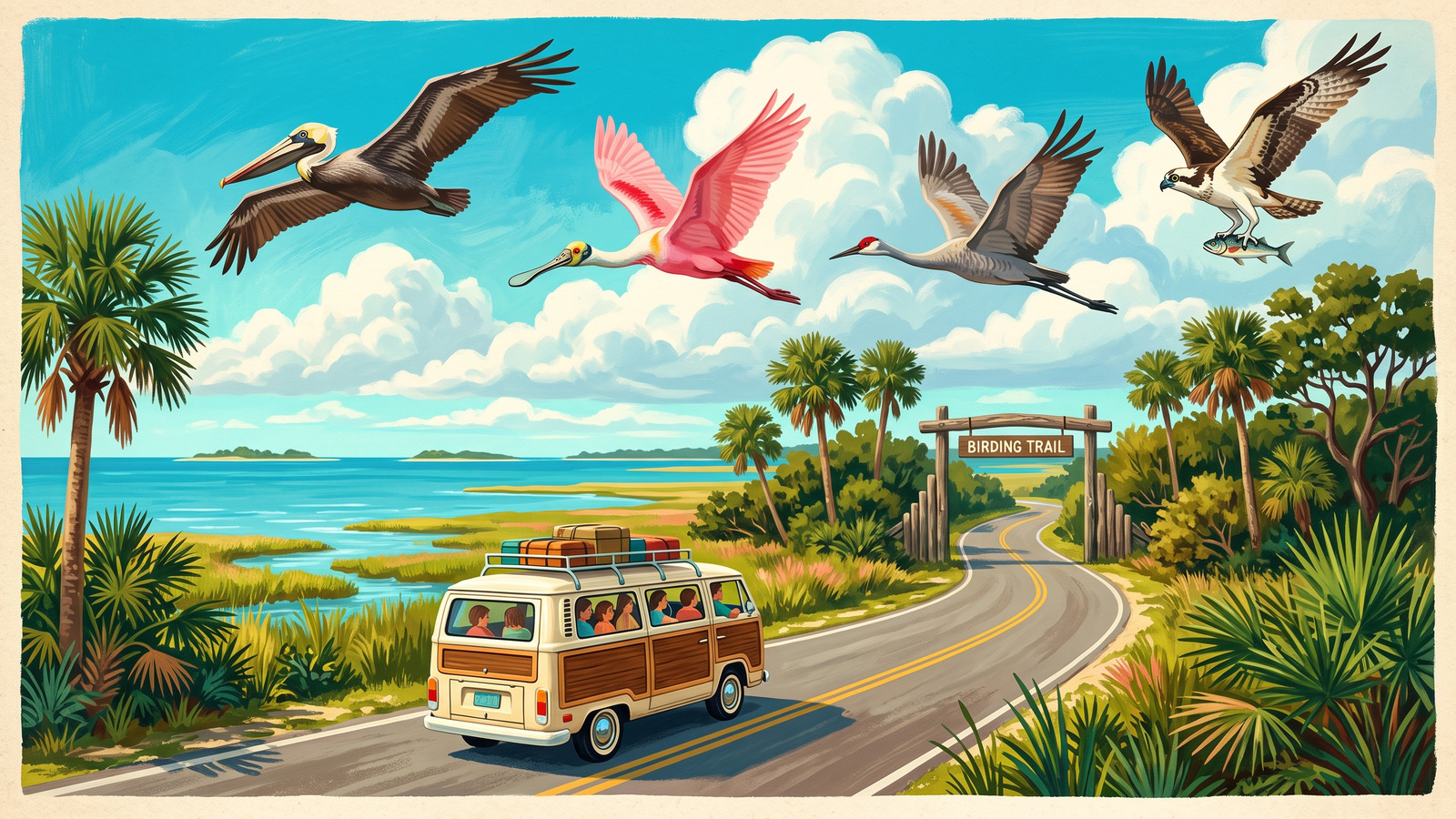
Somewhere on a back road this weekend, your family will pass a small brown sign with a stylized bird on it and keep driving, because nobody in the car knows it's a trail marker for one of the largest wildlife viewing networks in America. Florida quietly built a 2,000 mile treasure map with more than 500 marked sites, staffed the big ones, wrote up what lives at each, and then let the signs do the advertising. Consider this the decoder ring.
How the trail actually works
Think of it as a passport program rather than a footpath. The trail's four sections (Panhandle, East, West, South) each contain dozens to hundreds of member sites: parks, preserves, and refuges chosen because wildlife viewing there is genuinely good and reliably accessible, with new sites still being added by FWC. Brown highway signs mark members. Gateway sites, at least two per section, act as trailheads for the whole system, stocked with maps and advice. There's no fee, no required order, and no finish line, which makes it the rare attraction structured exactly like childhood curiosity.
The family version of the game: collect sites the way you'd collect stamps, keep the running bird list from your starter guide, and let the brown signs justify pulling over on any road trip in the state.
The five family stops, honestly rated
| Site | Why it works with kids | The specialty |
|---|---|---|
| Fort De Soto Park (gateway) | Beach + fort + birds in one outing | Spring migration, shorebirds, ospreys |
| Boyd Hill Nature Preserve | Compact loops, tortoises, raptor aviary | Owls, warblers, and resident rehab raptors up close |
| Weedon Island Preserve | Boardwalks, tower, free entry | Mangrove herons and eye-level ibis; full guide here |
| Sawgrass Lake Park | A mile of elevated boardwalk | Swamp birds and basking alligators, safely railed |
| Honeymoon Island State Park | Beach day with an osprey trail attached | Nesting ospreys, eagles some years, shorebird flats |
Every one of the five offers restrooms near the trailhead, stroller-workable main routes, shade for the meltdown hour, and birds big enough to need no binoculars, which is the entire art of family site selection.
Make it a scavenger hunt, not a hike
The trail's website lists each site's star species, and eBird shows what was seen there yesterday. Checking the night before converts a walk into a mission: we're going to Sawgrass Lake to find a limpkin. Kids who would mutiny at "a nature walk" will march happily against a target list, and the difference is entirely in the framing. Three targets is the right number; one should be nearly guaranteed (an osprey at Honeymoon Island is a gimme), one moderate, one a stretch that makes the day legendary if it lands.
Growing beyond the five
When the starter five are stamped, the West section holds 114 more, and the wider map turns any Florida trip into trail collecting: Circle B Bar Reserve on a Lakeland day, the sod fields and sparrow spots inland for the ambitious, Myakka River's towers on a Sarasota weekend, and the springs country sites on a one-tank trip north. A family that stamps twenty sites has, without ever calling it this, completed a survey course in Florida's ecosystems: beach, mangrove, hammock, swamp, prairie, and spring, each with its own cast.
The Little Naturalist activity
Make the passport literal. A small notebook, one page per site: name, date, weather, three birds seen, one sketch, one "best moment" line. Stamp it with a sticker per visit. The passport gives repeat visits a purpose (new season, new page) and, filled, it's the kind of childhood object that survives every future move. For homeschool families, it's also a portfolio artifact that outperforms most worksheets on every axis.
Questions families ask
Is the trail only about birds?
It was renamed the Great Florida Birding and Wildlife Trail for a reason: sites are chosen for all watchable wildlife, so tortoises, manatees, otters, and butterflies count. If your kid is a gopher tortoise partisan rather than a bird kid, the same passport works.
What should we bring beyond the usual park kit?
Water beyond what feels necessary, bug spray for the inland swamps, and the phone with Merlin and eBird loaded. Optics optional at the starter five; every site listed here shows its stars to the naked eye.
Are the sites safe and maintained?
Members are working public lands (county, state, federal) with normal staffing and hours; gateway sites add visitor centers. Standard Florida trail sense applies: stay on boardwalks, respect posted areas, and treat every pond edge with gator sense.
Can grandparents with limited mobility join?
The five above are among the region's most accessible wild places: paved or boardwalk main routes, benches at intervals, and parking near the action. Sawgrass Lake and Weedon Island in particular deliver real wilderness feeling at an entirely level grade.
Questions families ask
What is the Great Florida Birding and Wildlife Trail?
A statewide network of more than 500 wildlife viewing sites linked by a 2,000 mile self-guided route, run by the Florida Fish and Wildlife Conservation Commission. It's not one path but a treasure map: brown road signs mark member sites, and each region has flagship gateway sites with extra visitor help.
Which trail sites are best for families with young kids?
Near Tampa Bay, the five easiest are Fort De Soto Park, Boyd Hill Nature Preserve, Weedon Island Preserve, Sawgrass Lake Park, and Honeymoon Island State Park: all with boardwalks or flat trails, restrooms, shade, and big visible birds within a short walk of parking.
Does the trail cost anything?
The trail itself is free; individual sites charge their normal entry (county park tolls, state park fees, or nothing at all). A family can bird a different trail site every weekend for a season and spend less than one theme park morning.
How do we know what birds to expect at each site?
The trail's website lists every site with its specialty birds and best seasons, and the eBird app shows what's actually being seen there this week. Checking 'what's being seen' the night before turns a hike into a scavenger hunt with a fresh list.
Sources
More from the Bae
 LearnCornerstone
Birding with Kids Around Tampa Bay: The Starter Guide (Binoculars Optional)
How to start birding with kids around Tampa Bay: the big easy birds, the free Merlin app, five starter spots, and habits that make it stick.
 Learn
LearnFort De Soto in Migration Season: Why Birders Fly In from Everywhere Each Spring
Every spring, songbirds crossing the Gulf land first at Fort De Soto, and birders fly in from everywhere to greet them. A family migration guide.
 Learn
LearnA Family Guide to Weedon Island: Boardwalks, Herons, and a Thousand Years of History
Weedon Island Preserve packs boardwalks, an observation tower, mangrove paddling, and a thousand years of Tocobaga history into one free St. Pete morning.