Old Florida Words: Why It's Called Tampa, Pinellas, Manatee, and Pass-a-Grille
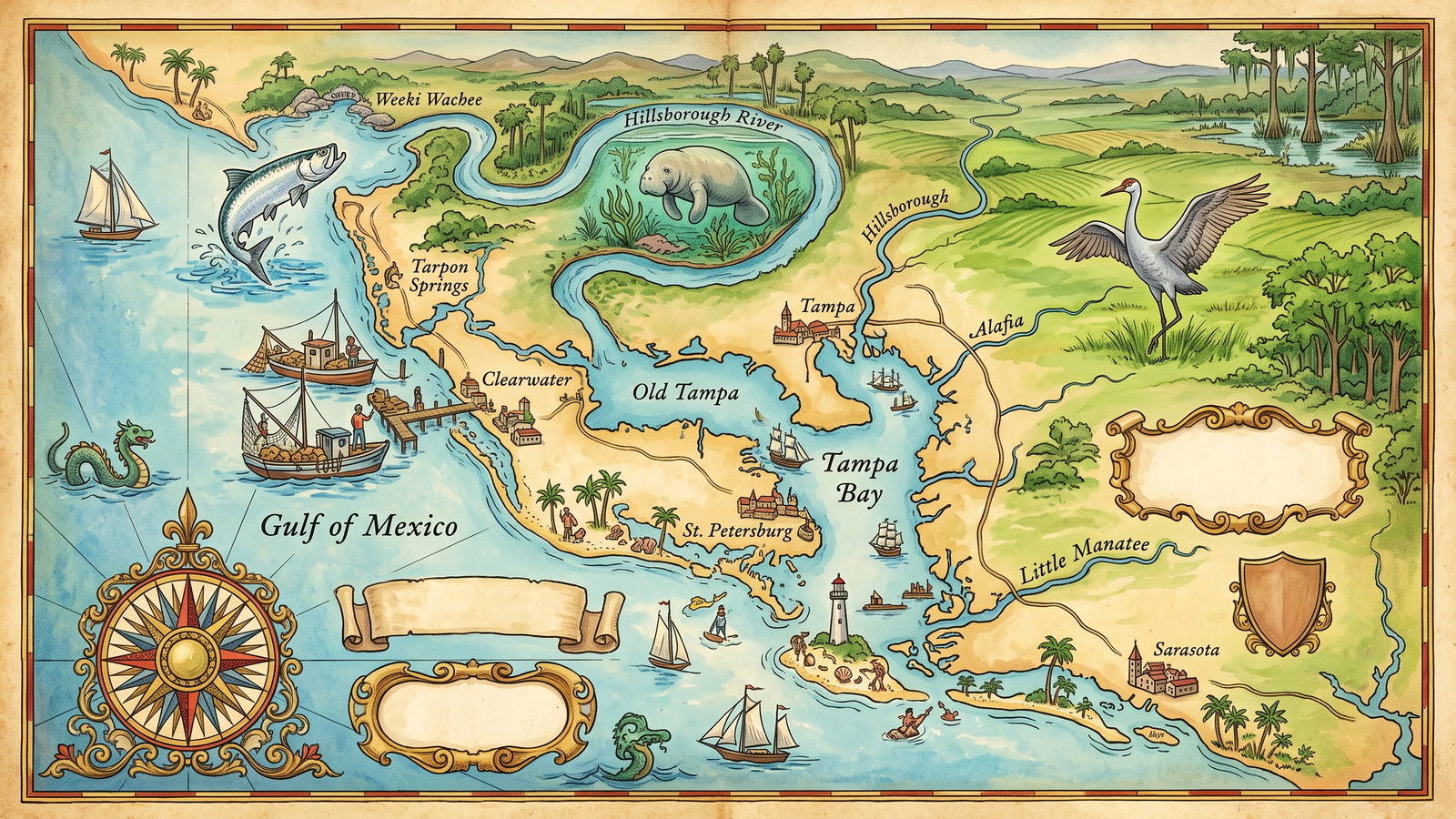
Your family speaks a dead language every single day and doesn't know it. Order the words correctly and a drive across the county becomes a séance: Tampa (a Tocobaga-era town, possibly "sticks of fire"), across the Howard Frankland to Pinellas ("point of pines," by way of a Spanish sailor squinting at the shoreline), down through Boca Ciega ("blind mouth") to Pass-a-Grille, where French-speaking fishermen once grilled mullet on the sand and accidentally named a beach town forever. Every sign on the commute is a fossil. This article is the field guide.
Layer one: the oldest words
The deepest names on our map came from the peoples who were here first, filtered, imperfectly, through Spanish record-keepers. Tampa leads the list: a 16th-century Spanish captive's memoir recorded a town called Tanpa in this region, and later scholarship often renders it "sticks of fire," with lightning (a local specialty then and now) among the guessed meanings; honest historians keep a "possibly" attached, and so should your kids, who by now know how to hold a maybe. Early mapmakers then dragged the name up and down the coast for two centuries before it stuck to our bay. Sarasota likely belongs in this oldest layer too, its origin genuinely unsettled, which makes it the map's standing mystery: a name whose meaning fell overboard somewhere in the 1700s.
The Tocobaga themselves named everything, of course; what survives of their language is fragments in Spanish documents, which is its own quiet lesson about what conquest costs beyond territory: words.
Layer two: the sailors' chart
Spain held this coast on paper for nearly 300 years, and its pilots labeled it like practical men. Punta Piñal, point of pines, marked our piney peninsula and mellowed over the centuries into Pinellas. Boca Ciega, blind mouth, flagged a bay whose entrance hides from seaward view, exactly the note a captain would want. The Anclote River and keys take their name from the Spanish for a kedge anchor, the sailor's tool for warping a ship along, suggesting the anchorage's use. Egmont and Hillsborough arrived in a brief British interlude (1763-1783), honoring the Earls of Egmont and Hillsborough, aristocrats who never smelled our salt air, which is how empire tended to decorate maps. Names in this layer share a tell: they describe utility (anchorages, entrances, landmarks) or flatter the distant powerful.
Layer three: the fishermen and the settlers
Then come the names people lived into. Pass-a-Grille carries the favored story of passe aux grilleurs, the pass of the grillers, French-tongued fishermen cooking their catch on the barrier sand; the spelling softened over generations into today's name, which locals rightly refuse to say quickly. Tarpon Springs was named for fish seen rolling in its bayous (the Greek chapter came later and kept the name). Clearwater states its springs plainly. Dunedin is Gaelic for Edinburgh, planted by Scottish merchants in the 1880s, which is why the town still throws Highland games. Safety Harbor names the shelter sailors found up the bay. And Manatee (county and river) honors the gentle giant your kids already know, one of the map's few names paid directly to an animal.
| The name | The layer | The meaning |
|---|---|---|
| Tampa | Native, via Spanish record | Possibly "sticks of fire" (debated) |
| Pinellas | Spanish chart | Punta Piñal, point of pines |
| Boca Ciega | Spanish chart | Blind mouth (hidden entrance) |
| Anclote | Spanish chart | Kedge anchor |
| Pass-a-Grille | French fishermen | Pass of the grillers |
| Dunedin | Scottish settlers | Gaelic for Edinburgh |
| Ybor City | Founder's name | Vicente Martinez-Ybor |
| Hillsborough, Egmont | British earls | Flattery at a distance |
| Manatee | The animal itself | Honest advertising |
| Sarasota | Unknown | The map's open case |
Layer four: the names we're adding
The cake is still baking, and kids should know they're watching layer four pour: subdivisions named for the groves they replaced (a citrus story hiding in every "Orange Grove Estates"), streets honoring local figures, and rebrandings that future kids will decode the way yours now decode Punta Piñal. A family that names things (the heron at the pond, the sandbar at the beach) is participating in the oldest local tradition on record.
The Little Naturalist activity
Run the name dig: each kid picks three names off your actual routes (school, groceries, beach) and plays detective: which layer? What's the story? Sources: this article, the library's local history shelf, and the town historical society's website. Then the capstone: write the "true name" entry for your own street as a 26th-century historian would, guessing at what confused them. Etymology is archaeology you can do in the car, and it never runs out of sites.
Questions families ask
Is "sticks of fire" really what Tampa means?
It's the most-cited translation of a name recorded five centuries ago from a language we hold only in fragments, so the honest answer is "probably something like that, and historians still argue." Teach the confidence level with the fact; that habit outlasts any single etymology.
Why did Spanish names survive when Spain didn't?
Charts. Sailors of every flag copied the existing maps rather than resurvey a dangerous coast, so Spain's labels outlived its rule by centuries. Names travel on paper, and paper outlasts empires: a tidy lesson in why writing things down matters, aimed gently at the child who won't keep a journal.
What about names that honor people we now question?
A real conversation, had honestly by cities as well as families: names carry the values of their namers, and communities periodically re-decide them. Kids who know how names arrived are precisely the citizens equipped for those debates later.
What's the oldest name still in daily use here?
Tampa has the deepest documented root, reaching back through the 1575 memoir toward the people who greeted the first sails. Every time your family says where it lives, it speaks a word older than every building in the state: which, said at bedtime, lands exactly as well as you'd hope.
Questions families ask
What does Tampa mean?
The best evidence traces it to a native town name, recorded around 1575 in a Spanish captive's memoir as Tanpa, and often translated as sticks of fire, possibly for lightning, though scholars debate it. The name wandered the maps for a while before settling on our bay and city.
What does Pinellas mean?
It comes from the Spanish Punta Piñal, roughly point of pines, the name early Spanish sailors gave the piney peninsula. Say it as point of pines and every county park with a pine flatwoods suddenly makes historical sense.
Why is it called Pass-a-Grille?
The favored story runs through French: passe aux grilleurs, the pass of the grillers, for the fishermen who hauled out on the pass to grill their catch. The name got smoothed by time and English mouths into Pass-a-Grille, which still smells faintly of the original if you say it hungry.
Why do so many places here have Spanish names?
Spain claimed and mapped this coast for nearly three centuries, so its sailors' names for capes, bays, and anchorages stuck to the charts that everyone afterward copied: Boca Ciega, Anclote, Punta Piñal. Names are the oldest surviving infrastructure in Florida; we drive on newer roads than words.
Sources
More from the Bae
 LearnCornerstone
Who Lived Here First? The Tocobaga of Tampa Bay, Told for Kids
The Tocobaga built shell-mound towns around Tampa Bay for centuries before Europe arrived. Their story, told for kids, and where families can stand in it.
 Learn
LearnGasparilla, the Pirate Who Probably Never Was: Legend vs. History for Kids
José Gaspar, Tampa's famous pirate, almost certainly never existed. How the legend was invented and why the city celebrates anyway.
 Learn
LearnThe Sponge Divers of Tarpon Springs: How Greek Families Built a Florida Town
In 1905, Greek divers from the Dodecanese islands turned Tarpon Springs into the sponge capital of the world. The story, and the family day at the docks.