
When Conquistadors Landed Here: The 1528 Expedition That Began at Our Bay
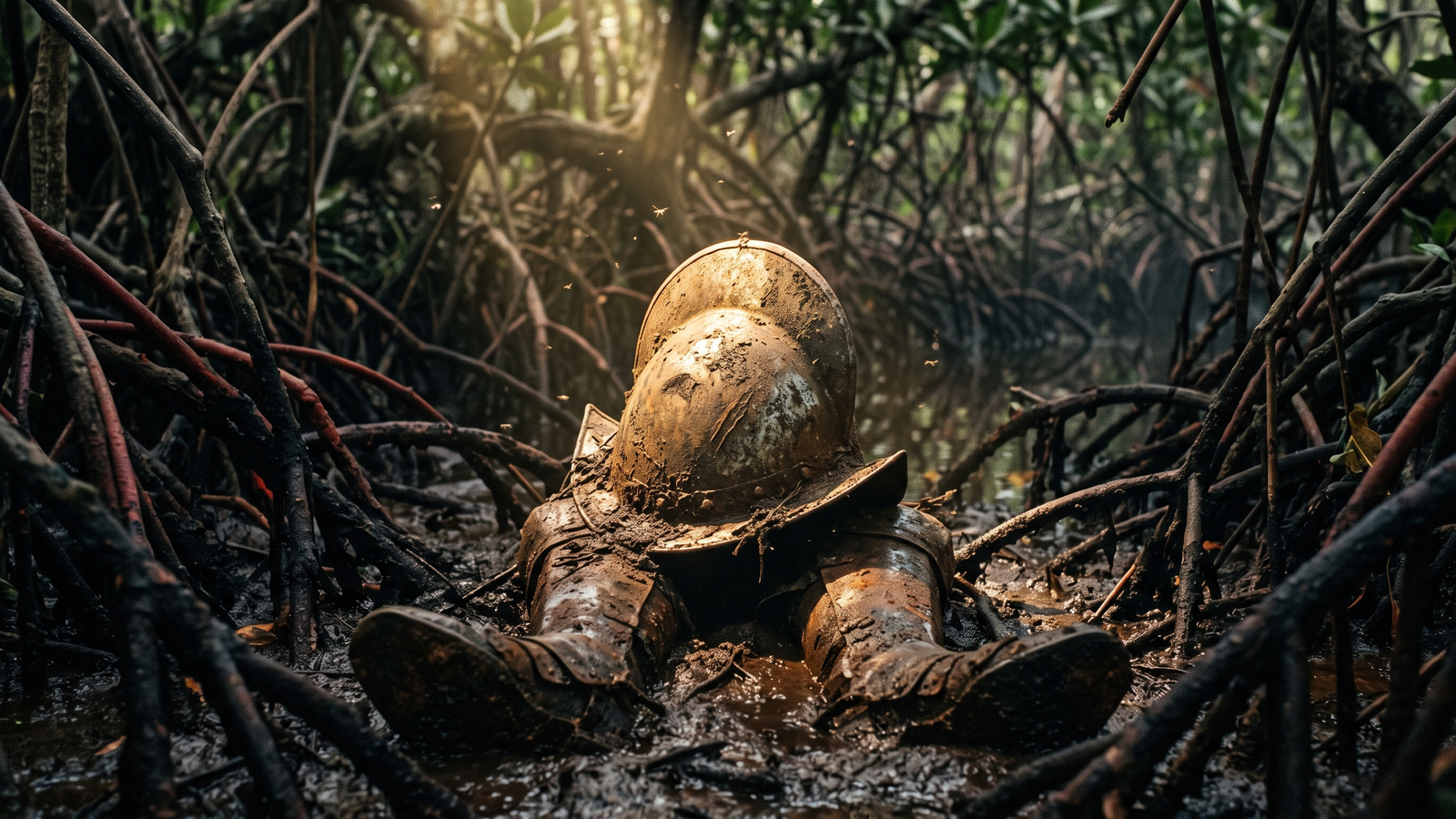
In a quiet St. Petersburg neighborhood, between a waterfront park and a restaurant parking lot, stands a shell mound with a story almost nobody at the nearby stoplight knows: in April 1528, three hundred armored men waded ashore more or less here, planted a flag, read a proclamation to the trees, and marched off to conquer Florida. Eight years later, on the far side of the continent, exactly four of them stumbled into a Spanish outpost in Mexico, alive against every odd, carrying one of the strangest survival stories in American history. It started at our bay. Your kids can stand on the spot before dinner.
The worst plan in Florida history
Pánfilo de Narváez arrived with a résumé of failure (he'd once been sent to arrest Cortés and lost an eye botching it) and a royal contract to conquer everything from Florida westward. Ashore near Boca Ciega Bay in April 1528, he made the decision every historian since has circled in red: he split his forces, sending the ships one way while marching 300 men north along the coast on foot, on the theory the fleet would be waiting ahead. The fleet never found them again. What the marchers found instead was Florida in summer: swamps, hunger, mosquitoes teaching their ancient seminar, and native nations (Tocobaga, Apalachee, and others) who had watched armored strangers demand gold and seize supplies, and who responded with ambush tactics the Spanish armor was useless against. The gold rumors that pulled the expedition north to the Apalachee country near today's Tallahassee proved to be exactly that: rumors, told partly, one suspects, to keep the visitors moving.
The escape by raft, and why kids gasp
By late summer the shrinking expedition, starving on the Panhandle coast, attempted one of history's great desperate engineering feats: with no shipwrights and no tools to spare, they melted their stirrups, crossbows, and spurs into nails and saws, killed their horses for food and hide (waterskins from whole horse legs), wove ropes from palmetto and horsehair, and built five crude rafts to coast toward Mexico, which they believed close. It was not close. Storms scattered the rafts along the gulf; Narváez himself drifted off aboard his raft one night, commanding to the last that it was every man for himself, and was never seen again. Two rafts wrecked near Galveston Island, Texas, in November 1528, delivering about 80 shivering survivors to a cold coast. Within months, disease, exposure, and hunger reduced them to a handful.
The eight-year walk
Here the story turns from disaster epic into something stranger and finer. Cabeza de Vaca, the expedition's treasurer, survived among Texas coastal peoples for years, first as a captive laborer, then as a traveling trader, and eventually, with three companions (Castillo, Dorantes, and Estevanico, an enslaved North African man whose survival skills the account repeatedly credits), as wandering healers whose reputation moved ahead of them from nation to nation. Passed and escorted community to community, the four crossed Texas and northern Mexico on foot over years, and in 1536, ragged and half-native in dress and speech, they met Spanish slave-raiders near the Pacific coast, an encounter Cabeza de Vaca describes with open ambivalence: the men he rejoined were hunting the kinds of communities that had kept him alive.
His account of it all, published as La Relación, became one of Europe's first detailed descriptions of North America's interior peoples, plants, and lands, and its author spent his later career arguing, decades ahead of policy, for humane treatment of native nations. History handed the microphone to a survivor, and the survivor used it better than his expedition deserved.
| The story in numbers | |
|---|---|
| Landed near Boca Ciega Bay, April 1528 | About 300 men |
| Reached the raft-building camp | Roughly 250 |
| Survived the Texas landfall winter | A handful |
| Walked into Mexico, 1536 | 4 |
| Years from landing to rescue | 8 |
| Distance, as the survivor walks | Thousands of miles |
Standing on the spot
The Jungle Prada site in St. Petersburg preserves what the neighborhood grew around: a substantial Tocobaga mound complex (the village stood here long before and after the Spanish morning in question) with public park access, interpretive markers for the 1528 landing, and the pleasant cognitive dissonance of five centuries sharing a block with a taqueria. Pair it with the Tocobaga capital at Philippe Park for the full frame: the expedition is one morning in a native city's thousand-year history, which is the proportion the first-peoples story deserves. Free, quick, stroller-fine, and the sunset from the adjacent park is a bonus the conquistadors were too busy to review.
The Little Naturalist activity
The raft problem: give kids the survivors' inventory (armor, stirrups, crossbows, horses, palmetto, hide) and the challenge: design an escape raft using only what they carried, then build a bathtub-scale model from equivalent scraps (foil for melted metal, twine for horsehair rope) and float-test it with a cargo of coins. Engineering under constraint is the lesson; the float test's usual outcome teaches the rest of the history with a splash.
Questions families ask
Was this the expedition Fort De Soto is named for?
No: Hernando de Soto's larger expedition entered Tampa Bay eleven years later, in 1539, having learned little from Narváez's fate, and cut its own harder path through the Southeast. The fort's name borrows de Soto; the 1528 story is Narváez's, and between them they explain why Spanish Florida stayed mostly coastal for generations: the interior said no.
How sure are historians about the landing site?
Confident about the bay, debating the beach: reconstructions from 500-year-old logs allow argument, and scholars have made careful cases for the Jungle Prada vicinity. Teaching kids that historians argue from evidence, and how, is half this article's toolkit value.
What happened to Estevanico?
His survival made him invaluable: within a few years Spanish authorities sent him north again as guide for the expedition seeking the fabled golden cities, where he was killed at a pueblo in today's New Mexico. His is among the first African names in the recorded history of the continental interior, and older kids find his thread of the story the one worth pulling hardest.
Is La Relación readable today?
In translation, remarkably so, and excerpts work aloud for middle schoolers: hunger, healing scenes, and the raft chapters especially. Reading a family chapter at the lector hour your house now runs closes a very satisfying loop.
Questions families ask
What was the Narváez expedition?
A 1528 Spanish expedition of roughly 300 men under Pánfilo de Narváez that landed on the shore of Boca Ciega Bay, near today's Jungle Prada site in St. Petersburg, with a royal commission to conquer Florida. It went catastrophically wrong, and only four members ever reached Spanish territory again, eight years later.
Who was Cabeza de Vaca?
The expedition's treasurer, Álvar Núñez Cabeza de Vaca, one of the four survivors. His eight-year walk from the gulf coast to Mexico, living among dozens of native nations as captive, trader, and healer, became a famous book, one of the first European accounts of the interior of North America.
Where exactly did they land in Tampa Bay?
Scholars' best case points to the Jungle Prada site on Boca Ciega Bay in St. Petersburg, where a preserved Tocobaga mound complex still stands and a marker commemorates the April 1528 landing. The precise spot is debated, as landing sites from 500-year-old accounts always are.
Is this story too intense for kids?
Told at the right altitude, it's a survival epic kids handle well: hurricanes, wrong turns, raft-building, and an eight-year walk home. The honest frame matters: the expedition came to conquer, the native nations it met were mistreated and fought back, and the sole survivors lived because native communities allowed them to.
Sources
More from the Bae
 LearnCornerstone
Who Lived Here First? The Tocobaga of Tampa Bay, Told for Kids
The Tocobaga built shell-mound towns around Tampa Bay for centuries before Europe arrived. Their story, told for kids, and where families can stand in it.
 Learn
LearnThe Mounds at Philippe Park: A Walk Through 1,000 Years in One Afternoon
Philippe Park in Safety Harbor holds the Tampa Bay region's largest temple mound, Florida's first grapefruit grove, and a free afternoon of real history.
 Learn
LearnOld Florida Words: Why It's Called Tampa, Pinellas, Manatee, and Pass-a-Grille
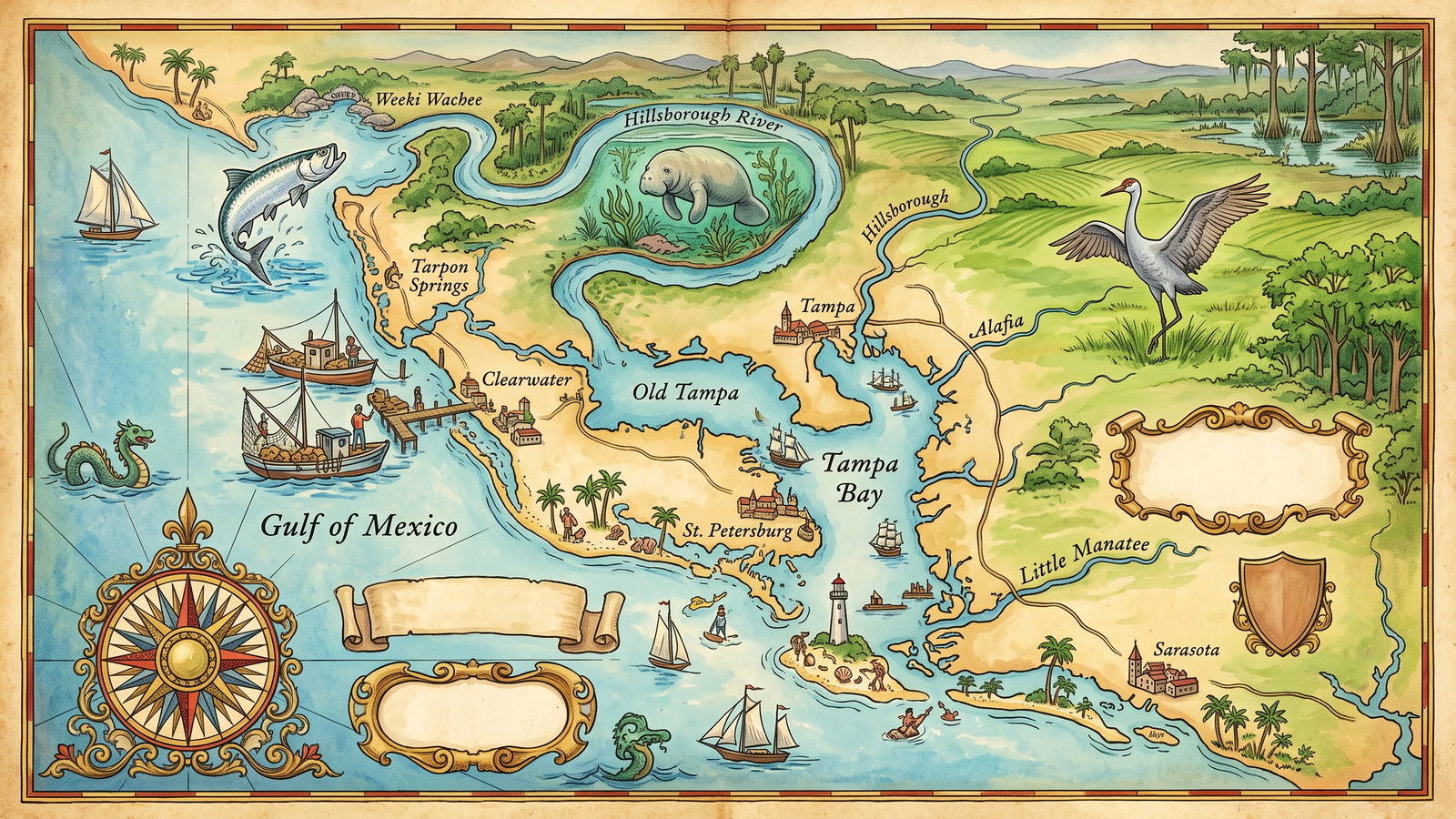
Tampa may mean sticks of fire, Pinellas is Spanish for point of pines, and Pass-a-Grille honors grilling fishermen. Local place names, decoded for kids.