
Fort De Soto's Hidden Batteries: A Spanish-American War Walk Kids Actually Love
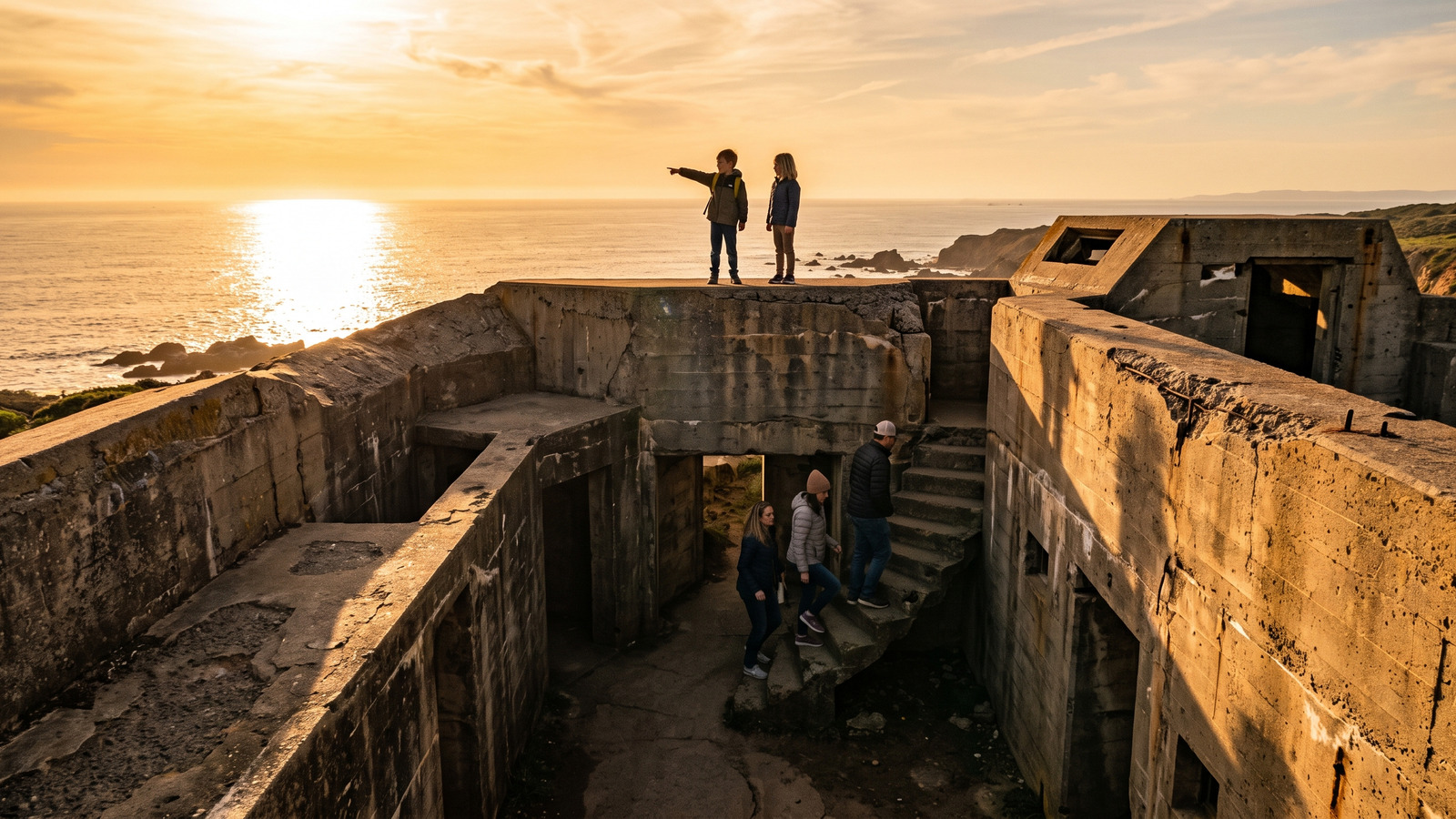
The best military museum in Pinellas County has no ticket booth, no velvet ropes, and four of the biggest artifacts in America sitting out in the sea air where kids can walk a full circle around them. Most families at Fort De Soto drive straight past it on the way to the beach, registering the low concrete hill by the parking lot as, maybe, a weird old wall. It is not a weird old wall. It is Battery Laidley, and inside its bunkers squat four cast-iron monsters found nowhere else in the continental United States.
Why there's a fort on a beach
Set the scene for the kids on the drive: in 1898, the United States went to war with Spain over Cuba, and Tampa, the nearest big port and rail head, became the Army's launch pad; Teddy Roosevelt's Rough Riders staged through the city on their way to fame. A war launched from Tampa meant Tampa Bay needed a locked front door, so the Army fortified both posts of the entrance: Fort Dade on Egmont Key, and Fort De Soto here on Mullet Key, batteries rising from 1898 with construction and a full military post (29 buildings by about 1906) following. The fleet the forts watched for never came; the guns drilled and waited, and the soldiers' true documented enemy, by their own accounts, was the mosquito. The post wound down after the war era, and the county eventually transformed the island into the park your family knows.
Both battery sites earned National Register of Historic Places listing in 1977, and one of the pair paid the coast's usual price: Battery Bigelow, closer to the water, was wrecked by the hurricane of 1921, its remains an object lesson in why this coast rearranges itself.
The mortars: last of their kind
Battery Laidley's crown jewels are its four 12-inch seacoast mortars, and "last of their kind on the mainland" is the literal claim: the final four carriage-mounted examples in the continental United States. Stand the kids beside one and work the machine backward: a mortar this size lobbed shells weighing as much as several grown adults in a high arc, designed to fall onto an enemy ship's thin deck rather than punch its armored sides: artillery as extreme pop-fly. Crews drilled to serve them in choreographed teams, hauling powder from the magazines through the cool concrete corridors your kids are about to explore. Those dim rooms (bring the phone flashlight) are the sensory core of the visit: echoes, iron doors, and the particular hush of thick concrete, which children exit speaking in the low voices of people who have been somewhere.
| The walk, in order | What kids get |
|---|---|
| The gun deck ramp | The four mortars, walk-around close |
| The magazines below | Flashlight rooms, echoes, iron fittings |
| The rampart top | Shipping-channel view; spot Egmont's lighthouse across |
| Quartermaster Museum | Free, small, and vivid: uniforms, photos, artifacts |
| The plaque hunt | Names, dates, and the 1921 hurricane's missing battery |
The Quartermaster Storehouse Museum, a faithful reconstruction opened on Veterans Day 2000, compresses the post's daily life into one room kids can absorb before the wiggles win: photographs of the garrison era, tools, uniforms, and the small human details (mail call, mess tables) that turn "fort" into "workplace of actual people, some of them nineteen."
History with a beach attached
The strategic genius of this field trip is its geography: the battery sits inside Tampa Bay's best all-around family park, so the hour of history buys the day at the beach, not instead of it. The complete circuit, run by generations of local families: battery and museum in the morning cool, picnic at the famous shelters, beach or bird sanctuary after lunch, ferry to Egmont if ambition holds. History first is the tested order; no child has ever left a beach voluntarily for a mortar.
The Little Naturalist activity
Arm the kids with the engineering question: why did the fort's designers bury the guns behind a low sand-and-concrete hill instead of building a tall castle? Let them inspect for their own answers (low silhouette, shells arcing over, walls that absorb hits), then confirm against the interpretive signs. Follow with the drawing assignment: design your own 1900 coastal battery, magazines and all. It's the rare history stop that teaches physics, and the sketches that come home are refrigerator-grade.
Questions families ask
Why is it called Fort De Soto if de Soto never built it?
The Army named the post for Hernando de Soto, the conquistador whose 1539 expedition entered Tampa Bay, a naming fashion of the era, honoring (uncritically, it must be said) the Spanish explorers. The actual Spanish landings hereabouts are their own wilder story, told in our 1528 expedition article.
Are the mortars safe to climb?
Kids may walk among and touch, not scale: the county preserves them in the open on trust, and the family rule (hands yes, climbing no) is what keeps last-of-their-kind artifacts unfenced for the next family. Rangers appreciate reinforcement.
What happened to Battery Bigelow exactly?
Built nearer the shoreline, it lost its footing to erosion and took its mortal blow from the 1921 hurricane; partial ruins remain toward the water. Two batteries, two fates, one lesson about building on barrier islands that Florida keeps enrolling in.
Is there a junior ranger or scavenger angle?
The park's interpretive signs support a self-made scavenger hunt nicely (find the 1898 date stamp, count the magazines, spot Egmont's light), and the Junior Ranger habit from the state parks transfers here in spirit. Ten minutes of parental prep turns the battery into a quest map.
Questions families ask
What is the fort at Fort De Soto?
Battery Laidley, built 1898-1906 to guard Tampa Bay's entrance during and after the Spanish-American War, together with its vanished sister Battery Bigelow. Laidley still holds the last four carriage-mounted 12-inch seacoast mortars in the continental United States, and kids can walk right up to them.
Did Fort De Soto's guns ever fire in battle?
Never at an enemy. The war ended before any threat reached Tampa Bay, and the post spent its service drilling, maintaining, and swatting mosquitoes, which soldiers' letters complained about more than any foe. The guns' silence is part of the story: deterrence that worked, or a war that moved on.
Is the fort walk stroller and grandparent friendly?
Mostly yes: the battery area is a short, flat walk from parking, with ramps to the gun deck level. The interior magazine rooms involve steps and dim passages, which is precisely why kids rate them so highly. The free Quartermaster Museum nearby is fully accessible.
How long does the history part of Fort De Soto take?
An hour covers the battery, the mortars, and the museum at a kid's pace, which leaves the rest of the day for the park's beaches, pier, and ferry. History here is the appetizer to Tampa Bay's best all-around family park.
Sources
More from the Bae
 Learn
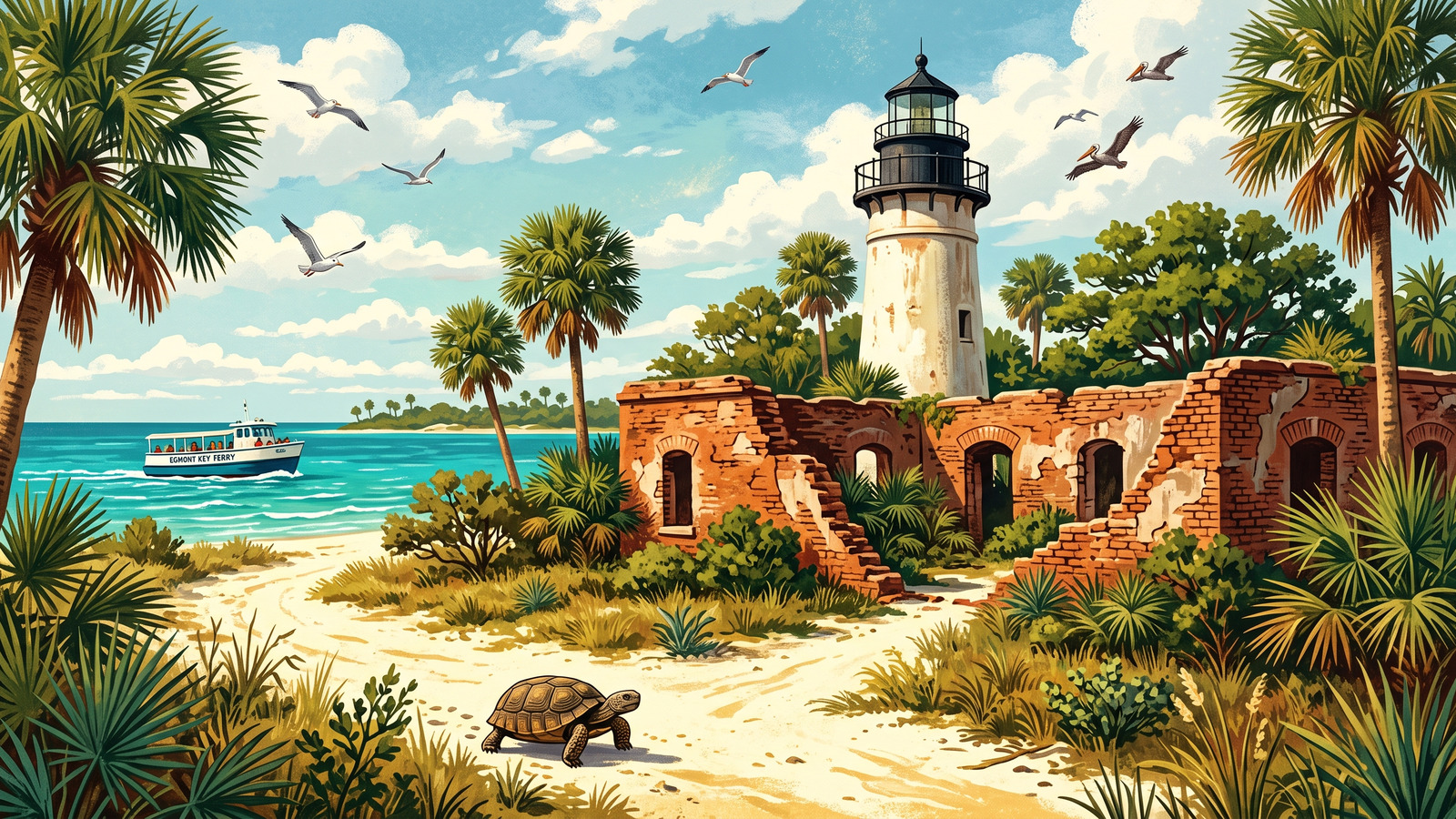
LearnEgmont Key by Ferry: Lighthouse, Fort, and Tampa Bay's Best History Field Trip
Egmont Key packs an 1858 lighthouse, Fort Dade's ruins, brick ghost-town streets, and a ferry ride with dolphins into Tampa Bay's best history field trip.
 Learn
LearnFort De Soto in Migration Season: Why Birders Fly In from Everywhere Each Spring
Every spring, songbirds crossing the Gulf land first at Fort De Soto, and birders fly in from everywhere to greet them. A family migration guide.
 Learn
LearnGasparilla, the Pirate Who Probably Never Was: Legend vs. History for Kids
José Gaspar, Tampa's famous pirate, almost certainly never existed. How the legend was invented and why the city celebrates anyway.