
Fort De Soto in Migration Season: Why Birders Fly In from Everywhere Each Spring
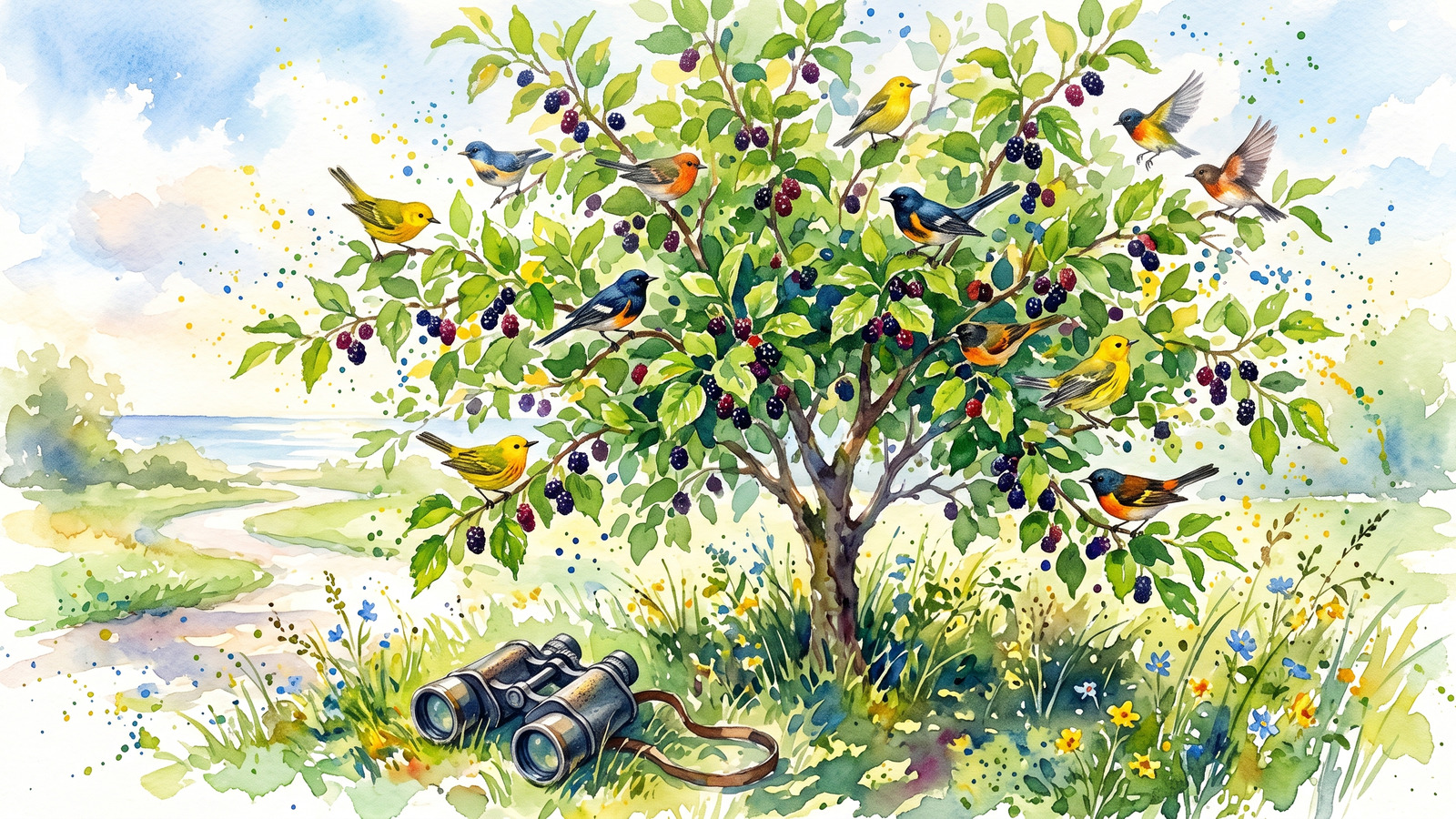
Every April, in the parking lots of a county park at the bottom of Pinellas, you can watch people from Ohio, Oregon, and occasionally Norway assemble optics worth more than their rental cars, all to stand under a mulberry tree. They have flown a thousand miles to be here. So, it happens, have the birds, except the birds did it without an airplane, without stopping, over open water, and some of them weigh less than a quarter. Fort De Soto in migration season is where those two journeys meet, and it's a twenty-minute drive from your house.
The journey your kids should hear first
Tell the story before the trip, because the story is the point. A scarlet tanager wintering in South America decides, on ancient cue, to head north. It feeds heavily on the Yucatan coast, doubles its fat, and one evening launches out over the Gulf of Mexico: 500 miles or more of open water, no rest, no food, eighteen hours or more of continuous flying through the dark. If the winds help, it makes the crossing with reserves to spare and continues inland. If the winds turn or storms rise, it burns everything it has, and the first land it sees is the tree line of a barrier island at the mouth of Tampa Bay.
That's Fort De Soto's whole secret: it's the first exit after the longest bridge in the bird world. The travelers that drop in are exhausted, famished, and focused entirely on mulberries and insects, which is why a seven-year-old standing quietly can watch an indigo bunting feed at arm's length: a bird that, days earlier, was in Mexico.
What a fallout is, and why birders whisper about it
Most April mornings, migrants trickle through: a handful of warbler species in the oaks, an oriole in the mulberries, tanagers flashing through like struck matches. But when a cold front or gulf storm meets a big overnight flight, the sky essentially puts everyone down at once. Birders call it a fallout: hundreds of birds of dozens of species filling every tree, fence, and picnic table, too tired to care about the humans weeping quietly into their binoculars. Fallouts are unpredictable, a few mornings a spring at most, and they're the reason people book flights on 48 hours notice. For a family, even a normal April morning delivers; a fallout delivers a memory with a permanent shelf.
The honest flip side, worth teaching: a fallout means the birds had a terrible night, and the park is their emergency room. Quiet voices, distance from feeding birds, dogs left home, and no chasing anything into flight. The shorebird ethic applies to the woods in April.
The family game plan
| Detail | The play |
|---|---|
| Season | Late March to early May; mid-April is peak |
| Best conditions | The morning after north winds or gulf storms |
| First stops | Mulberry trees by East Beach, oaks near the ranger station, Arrowhead trail |
| Timing | Early morning; birds feed hardest before heat |
| Bring | Water, hats, quiet shoes, snacks for your own migration |
| Kid mission | Count colors, not names: red, blue, orange, yellow all show daily |
| Bonus | Beach, fort, and ferry afterward; it's still Fort De Soto |
Don't be shy about the crowd: birders in season are the friendliest infrastructure in the park, delighted to aim a scope at a painted bunting for a child. Kids who ask "what are you seeing?" get shown things all morning.
Fall works too
The southbound trip, August through October, runs the show in reverse: less concentrated, longer, and heavier on immature birds practicing their field marks, plus the shorebird flocks staging on the flats. It lacks spring's champagne moments and beats it for elbow room. A family that does one April morning and one October morning has seen the whole engine turn over.
The Little Naturalist activity
Build a migration map. Before the trip, have kids trace the routes: South America to the Yucatan, the gulf crossing, the Fort De Soto landfall, then north to nesting grounds as far as Canada. After the trip, mark every color they counted and look up where each likely bird was headed. The mulberry tree becomes an airport departure board, and geography homework never recovers, in the best way.
Questions families ask
What birds will we actually see in April?
On a fair morning: several warbler species, indigo buntings, orchard and Baltimore orioles, summer and scarlet tanagers, grosbeaks, and thrushes, plus the resident cast. On a great morning, twenty-plus migrant species. The mulberries decide; your job is presence.
Do we need to know bird names for this to work?
No. Migration is the one birding event where spectacle precedes vocabulary. Run Merlin's sound ID from the starter guide, let the neighboring scopes share, and collect names casually. The awe arrives regardless.
Is there an entrance fee or crowds problem?
The county toll and parking are modest, and April mornings are busy but civil; the birders self-organize with remarkable courtesy. Arrive early for parking near the wooded areas, and never park on vegetation, which in this park may be holding a resting migrant.
Why do the birds cross the gulf at all instead of going around?
Some do go around, following Texas. The over-water route is shorter and, with a tailwind, cheaper in energy, a gamble evolution keeps because it usually pays. The ones that land at Fort De Soto exhausted are the gamble's edge cases, which is precisely why the park's trees, and the manners of the people under them, matter as much as they do.
Questions families ask
Why is Fort De Soto famous for bird migration?
Geography. Songbirds crossing the Gulf of Mexico in spring fly hundreds of miles nonstop, and Fort De Soto's wooded park at the mouth of Tampa Bay is among the first land they see. Exhausted migrants drop into its oaks and mulberries to rest and refuel, sometimes by the hundreds, at arm's length.
When is the best time to see migration at Fort De Soto?
Roughly late March through early May, with mid-April the classic peak. The biggest days often follow north winds or storms over the gulf, which force tired birds down in what birders call a fallout. Any April morning is worth the trip; the day after rough weather can be unforgettable.
Where exactly do you look for migrants in the park?
The wooded areas: the famous mulberry trees near East Beach, the oaks around the ranger station and picnic areas, and the Arrowhead nature trail. Migrants concentrate wherever there's shade, water, and fruit, and in season you'll also find a helpful concentration of birders pointing.
Is a migration morning good with kids?
One of the best birding experiences a child can have: the birds are close, brightly colored, and too tired and hungry to be shy. Bring water, go early, keep voices low near the trees, and let kids count colors rather than names: an April mulberry can hold a dozen species at once.
Sources
More from the Bae
 LearnCornerstone
Birding with Kids Around Tampa Bay: The Starter Guide (Binoculars Optional)
How to start birding with kids around Tampa Bay: the big easy birds, the free Merlin app, five starter spots, and habits that make it stick.
 Learn
LearnBaby Shorebirds on Our Beaches: What the Roped-Off Areas Protect, and How to Teach the Why
Those roped-off beach areas protect eggs and chicks you can't see: skimmers, terns, and plovers nesting February 15 to August 31 on Tampa Bay sand.
 Explore
Fort De Soto with Kids: Beach, Fort, Ferry, and the Best Picnic Tables in Florida
Fort De Soto with kids: the North Beach lagoon, the 1898 fort, the Egmont ferry, the Paw Playground, camping, and the full family day.