
Egmont Key by Ferry: Lighthouse, Fort, and Tampa Bay's Best History Field Trip
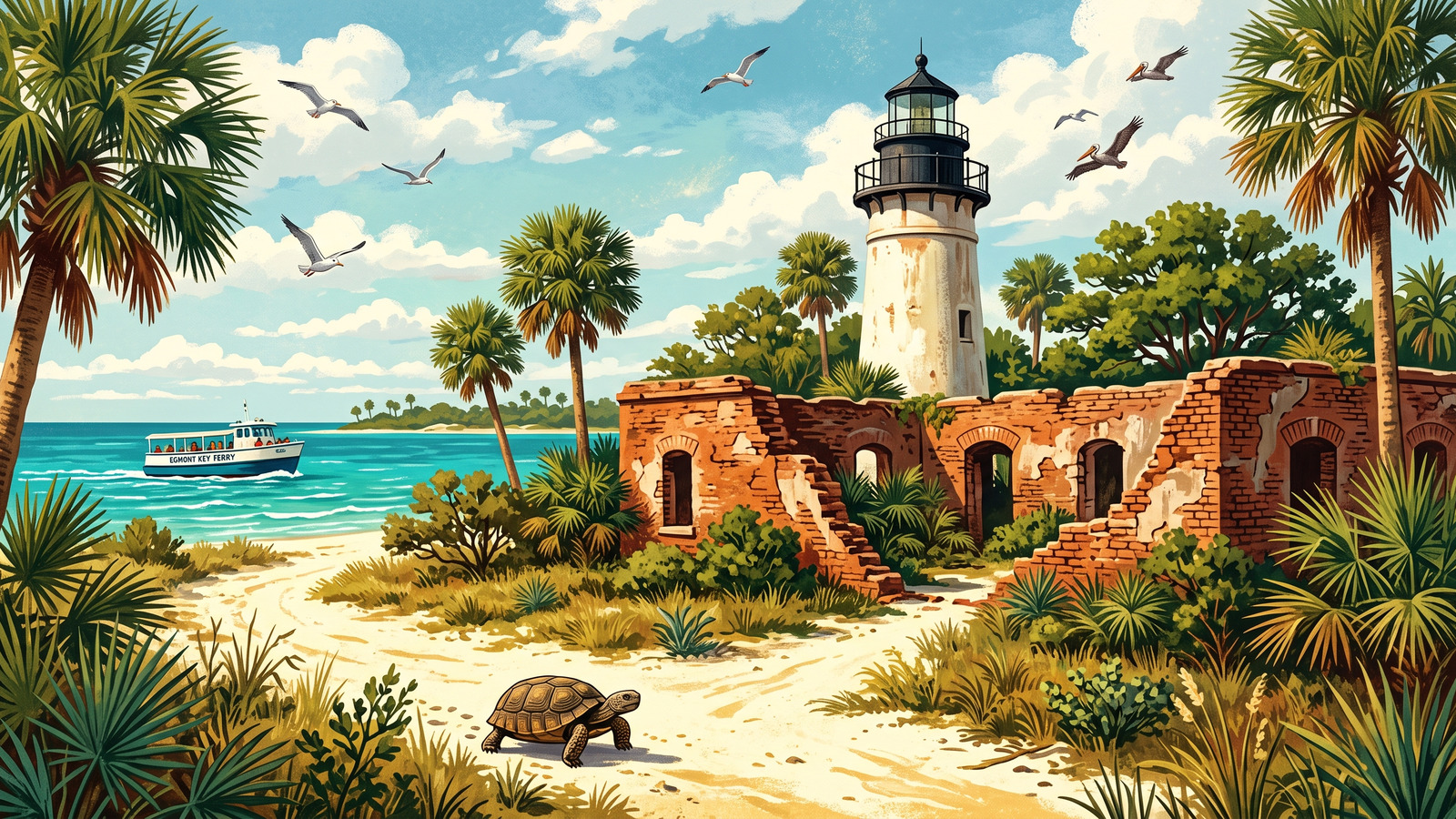
There's an island at the mouth of Tampa Bay where the streets are brick, the streetlights are gone, and the residents are gopher tortoises. You reach it by ferry, past dolphins that escort the boat like they're on payroll. You walk avenues where 300 soldiers and their families once had electricity, telephones, a hospital, and a baseball diamond, all of it now emptied to sun, palms, and the sound of surf working through the ruins of gun batteries. Egmont Key is the closest thing Florida offers to time travel with a snack bag, and it's visible from your beach towel at Fort De Soto.
The lighthouse that refused to quit
Start the story with the tower, because it starts everything here. The first Egmont lighthouse rose in 1848, the only light between St. Marks and Key West, and within months the great hurricane of that year (tides reported fifteen feet above normal) wrecked it; the keeper, by the era's telling, rode out the storm and rowed away from the ruin. Congress paid for a replacement built to a simple specification: withstand any storm. The 1858 tower has been doing exactly that ever since, through every hurricane this coast has thrown, and it still guides ships today. Kids should touch its base and do the math: the lighthouse is older than the Civil War, older than Tampa's cigar factories, older than the state's oranges being anyone's business, and it has never once blinked.
The hard chapter, told straight
Before the fort, the island held a darker duty, and this site doesn't skip hard chapters: during the end of the Third Seminole War in the 1850s, Egmont Key was used as a detention camp for captured Seminole people, including the leader Billy Bowlegs, before their forced removal west. Families died here far from home. Tell it the way we told the Tocobaga story: honestly, briefly, at eye level. The island your kids are enjoying was, for some families, the last Florida ground they stood on, and remembering that truthfully is part of the visit's value. The Seminole nations endure today, in Florida and Oklahoma, which is the note of continuation kids need to hear.
Fort Dade: the town the war built
In 1898, with the Spanish-American War on and Tampa the Army's staging port, the military fortified the bay's front door: Fort Dade here, Fort De Soto across the channel, twin guardians whose guns, as it turned out, never fired at an enemy. Fort Dade kept growing anyway: by 1906 it was a genuine town of 300-plus, with brick roads, electricity, telephones, a hospital, movie house, and ball fields. The Army closed it in 1923, and the island began its long exhale back to wild. What remains is the best kind of ruin for children: batteries to peer into (flashlight territory), brick avenues running through palm forest to nowhere, and the eerie, wonderful arithmetic of a whole town's outline with the town removed. Parts of the fort now sit offshore underwater, where snorkelers drift over gun emplacements, because the island itself has been shrinking and shifting for a century, a live geology lesson bundled free with the history.
| The expedition, planned | Notes |
|---|---|
| Getting there | Ferry from Fort De Soto (seasonal schedule); private boats and St. Pete Beach tours |
| Time ashore | 3 to 4 hours on the standard boats |
| Bring | Everything: water, food, shade, sunscreen, reef-safe snorkel gear |
| Facilities | Minimal to none; this is the point |
| The residents | Gopher tortoises in numbers; give burrows their ten feet |
| The escort | Dolphins work the ferry channel most crossings |
| Rules | Refuge zones are marked and closed; lighthouse area and marked trails only |
Wildlife holds the deed now
Egmont is jointly a state park and national wildlife refuge, and the animals act like they know it: gopher tortoises graze the old parade grounds in numbers that delight children raised on the little landlord, shorebirds and terns nest in closed refuge zones (the ropes-and-respect rules from our shorebird story apply island-wide), and the ferry crossing produces dolphins with near-contractual reliability. The island's south end stays closed for nesting; the open north gives families the lighthouse, ruins, and swimming beaches. It's the rare field trip where the history and the wildlife are the same walk.
The Little Naturalist activity
Ghost-town cartography: hand kids a clipboard on the boat and have them map the town as they find it: brick roads, battery positions, foundations, the lighthouse, guessing at what each ruin was before an adult reads any sign. Then compare their deduced map against the posted historical one. Reading a vanished town from its bones is real archaeology method, and Egmont is the safest, sunniest dig site a family could ask for.
Questions families ask
Is the lighthouse climbable?
No: it's a working aid to navigation, admired from its base. The keeper's-era buildings and grounds around it carry the story, and the tower's exterior, weathered and working, is the photograph anyway.
Is the snorkeling actually good for kids?
On calm days, yes: shallow water over fort rubble holds fish, and confident swimmers can float above history, an unforgettable combination. It's open water, so life jackets for young swimmers per the water rules, calm-day judgment, and one adult designated as watcher, always.
Why is the island shrinking?
Currents, storms, and sea rise have been reshaping Egmont for a century, taking acreage and pulling fort structures into the surf. Engineers periodically renourish and armor sections. It's a gentle, visible way to talk with kids about coasts as moving things, a theme every beach kid eventually asks about.
Ferry logistics: book ahead?
In season and on weekends, yes, reserve; boats fill. Check the operator's current schedule before promising the day, have a backup plan (Fort De Soto itself absorbs any disappointment), and remember the crossing is short enough for even boat-wary kids to manage happily.
Questions families ask
How do you get to Egmont Key?
By boat only: the passenger ferry from Fort De Soto Park is the family standard, a short crossing that doubles as a dolphin tour most days. Private boats and some tour operators from St. Pete Beach also make the run. There's no bridge, no cars, and no concessions, which is exactly the charm.
What is there to see on Egmont Key with kids?
A working lighthouse first lit in 1858, the ruins of Fort Dade's gun batteries, ghost-town brick streets from a 300-person military community, gopher tortoises everywhere, shelling beaches, and snorkeling over parts of the old fort now underwater off the beach.
How much time do you need on Egmont Key?
The ferry schedule sets the day: most families take the morning boat over and an early afternoon return, giving three to four hours, which comfortably covers the lighthouse walk, fort ruins, a picnic, and swim time. Bring everything; the island sells nothing.
Why was there a fort on Egmont Key?
The island guards the main shipping entrance to Tampa Bay, so when the Spanish-American War broke out in 1898, the Army built Fort Dade here (with Fort De Soto across the channel) to protect the bay. It grew into a full town, brick roads and all, before closing in 1923.
Sources
More from the Bae
 Learn
LearnThe Dolphins of Tampa Bay: What Your Kids Are Seeing Out There, and the One Rule That Protects Them
Tampa Bay's bottlenose dolphins live here year-round, have names for each other, and are protected by one big rule: never feed a wild dolphin.
 Learn
LearnThe Gopher Tortoise: Florida's Little Landlord and the 350 Neighbors in Its Burrow
The gopher tortoise digs burrows that shelter 350 other species. Where families can see Florida's little landlord, and the never-put-it-in-water rule.
 LearnCornerstone
Who Lived Here First? The Tocobaga of Tampa Bay, Told for Kids
The Tocobaga built shell-mound towns around Tampa Bay for centuries before Europe arrived. Their story, told for kids, and where families can stand in it.