
The Dalí with Kids? Yes, Really: How to Do an Art Museum with Young Ones
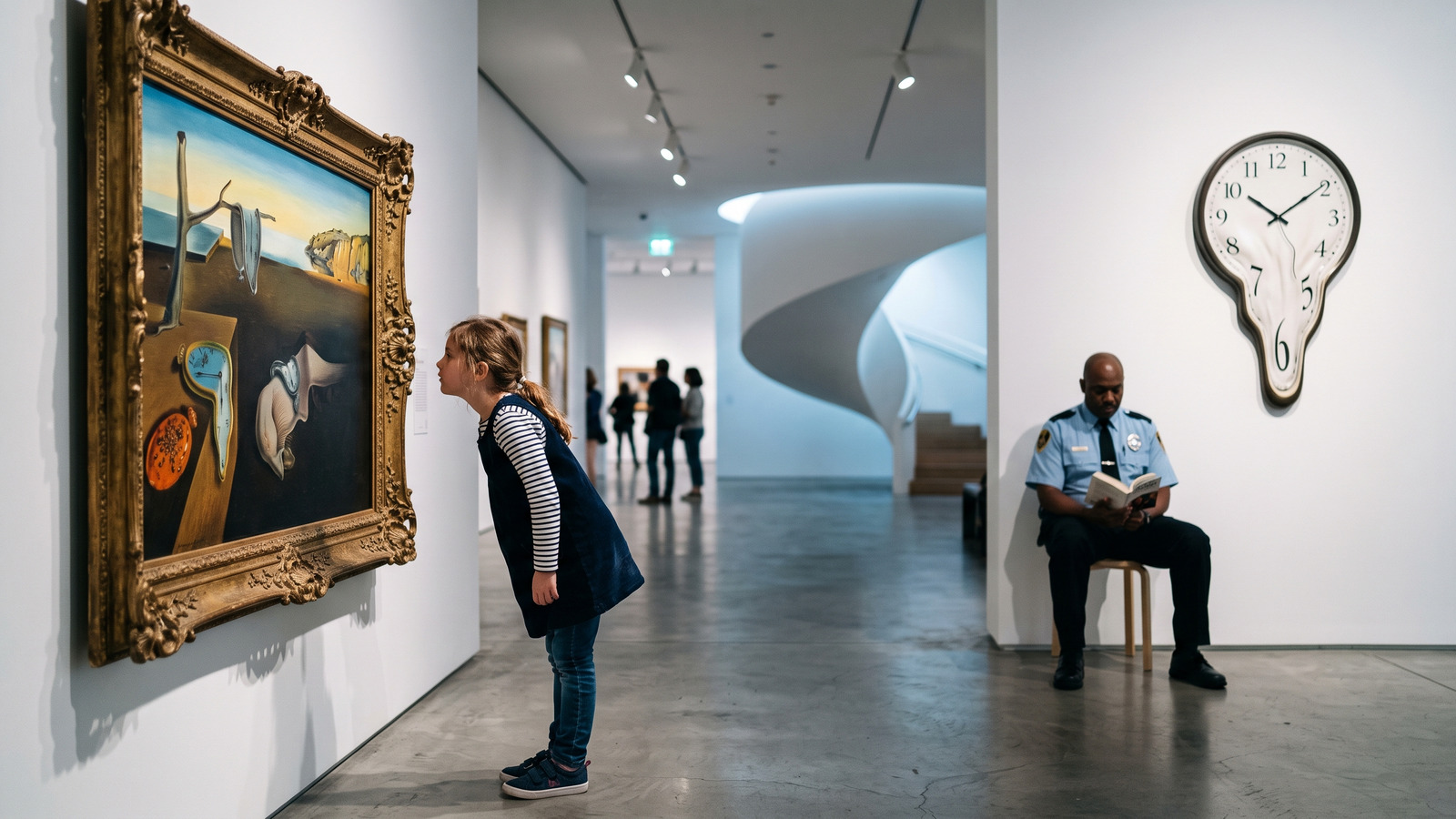
Here is the secret the art world keeps accidentally: of all the museums to introduce a child to, the one dedicated to a mustachioed Spaniard who painted melting clocks is the easy one. Children are native surrealists: they draw impossible animals on purpose, they find faces in furniture, they consider a burning giraffe a reasonable narrative choice: and so the Dalí Museum in St. Pete, which adults approach as Serious Art, reads to a seven-year-old as the work of a colleague. Add a building that looks like a glass bubble escaping a concrete box and a garden with a bench shaped like a mustache, and you have the region's most counterintuitive family win. Here's how to run it.
Why surrealism is the on-ramp
The pedagogy deserves one plain paragraph: most art museums ask children to admire technique, which is asking them to appreciate someone else's homework. Surrealism asks them to decode, and decoding is play. Dalí built his big canvases as double and triple images: stare at the fruit dish until it becomes a face, the crowd until it becomes a bust of Voltaire, the landscape until the dog appears: and the moment of resolution (the gasp, the pointing) is identical to the moment a kid spots the camouflaged plover or reads the rip current's gap: pattern-finding, this series' home sport, played indoors on canvas. Kids don't need the biography or the movement's theory (though the museum tells both well for the teens who ask): they need to be told there are hidden pictures, and released.
The visit, run as a hunt
The building opens the show: the Dalí's home is architecture kids point at: the concrete treasure-box hull, the free-form glass Enigma bubbling out of it (73-plus feet of geodesic wonder), and inside, the helical staircase spiraling up like a DNA strand or a lightning whelk: the family photo op is the stairwell, and taking it first burns arrival energy before gallery manners are needed.
The galleries, one loop, hunt method: collect the family guide at the desk (the museum publishes kid-aimed materials and runs family programming: ask what's current), pick six or eight stops rather than everything, and run each the same way: thirty seconds of silent looking, then the question: "what do you see that I don't?" The masterwork rooms (the monumental double-image canvases) are the boss levels: let kids find the hidden faces before any adult confirms, and let them disagree: surrealism grades generously. The melting clocks (the museum's collection spans the famous imagery even as specific loans rotate) anchor the vocabulary every kid arrives with.
The garden closes it: out the back, the waterfront Avant-garden: the labyrinth to walk, the mustache bench for the photo, the harbor breeze for the decompression: the museum-day cooldown this cluster keeps prescribing, with sailboats.
| The plan | The move |
|---|---|
| Duration | 90 minutes to 2 hours, hard stop while happy |
| The method | Six-stop scavenger loop; kids find, adults confirm |
| The photo | The spiral staircase, then the mustache bench |
| The budget | Little kids typically free; passes and free evenings for the rest |
| Best times | Weekday opening; family program days |
| The pairing | Waterfront walk, downtown St. Pete lunch |
The manners, taught as craft
Art museums come with the one genuinely new behavior set this cluster asks of kids, so teach it as professional equipment, not restriction: the eighteen-inch rule (pointing happens from a forearm's distance: docents everywhere bless the family that teaches the hover-point), gallery voice (the mangrove-tunnel register, indoors), and the sketchbook option (many art museums welcome pencil sketching: a kid copying the melting clocks onto a pocket pad has upgraded from audience to practitioner, and guards smile at them all day). Framed this way (this is how the professionals visit), children adopt the code the way they adopted pier handling manners: as insider technique.
The Little Naturalist activity
Run the surrealist studio at home, same week: each family member paints or draws one double image (a face hidden in a landscape, an animal in the furniture: Dalí's actual homework), then the gallery opening: works taped up, artist statements delivered, hidden images hunted by the audience. The exercise closes the loop the museum opened (from decoding to encoding), and it reliably produces at least one refrigerator piece the family will defend for years. Bonus credential: the kid who has made a double image can never again be told modern art is easy.
Questions families ask
What about the surrealism that's genuinely weird or unsettling?
Dalí has rooms that run adult (dreams are not curated for children), and the family method handles it naturally: your six-stop loop chooses the stops, docents point family-friendly paths gladly, and the honest answer to "that one's strange" is the movement's whole thesis: dreams are strange, and he painted his. Kids accept that with suspicious ease.
Is there anything hands-on for the youngest?
The building, the garden, and the museum's family-program days carry the under-6 crew: check the calendar for kid-aimed offerings before a toddler visit, or run the Great Explorations pairing and save the Dalí for the 6-plus season. The staircase forgives all ages.
How does the Dalí fit the free-access system?
Kids under the museum's threshold enter free, evening and discount traditions exist, and pass-program participation varies: check current rosters. It's the circuit's premium ticket either way: worth one full-fare family visit a year on its merits.
After the Dalí, what's the art path for a hooked kid?
Downtown St. Pete is the region's gallery district: the museum-dense waterfront, murals walkable by the mile, and monthly art-walk traditions: plus the classic pipeline of classes at local art centers. The kid who found the hidden face is asking to make one: the studio activity above is the first step, and the city can carry it from there.
Questions families ask
Is the Dalí Museum really kid-friendly?
Surprisingly, famously yes: surrealism is the one art movement children are already fluent in (melting clocks and impossible animals are how kids think), the building itself (the glass Enigma bubble, the spiral staircase) is an attraction, and the museum leans in with family guides and activities. Young kids typically enter free.
What will kids actually like at the Dalí?
The hunt: Dalí's big masterworks hide double images (find the face in the fruit bowl, the bust in the crowd), which turns the galleries into a puzzle room. Add the melting clocks, the outdoor garden with its mustache bench and labyrinth, and the wind-down waterfront, and it's a genuine two-hour family win.
How long should a family plan at the Dalí?
Ninety minutes to two hours: one focused gallery loop with the scavenger method, the garden, and the gift shop's melting-clock negotiation. Art museums with kids run on quality minutes, not coverage: leave while it's still fun.
When is the best time to bring kids to the Dalí?
Weekday mornings at opening, or the museum's family programming days: the galleries are calmest, the docents most available, and the waterfront garden makes the pre-lunch finale. Check current family offerings and free-evening traditions before booking.
Sources
More from the Bae
 Learn
LearnFree Museum Days and Library Passes Around Tampa Bay: The Family Calendar
Free museum access around Tampa Bay: Hillsborough's Discovery Pass, the Pinellas library museum pass program, community free days, and the family system.
 Learn
LearnMOSI or Glazer? Choosing Tampa's Science Museums by Age
MOSI or Glazer Children's Museum? The honest age guide to Tampa's two science stops: Glazer under 8, MOSI's hands-on science for the bigger kids.
 Explore
Rainy Beach Day? The Backup Plan That's Better Than the Original
When Tampa Bay's 4 p.m. storms cancel the beach: the lightning rules, the wait-it-out math, and the indoor backup plans that outperform the original.