
Sandhill Cranes in the Neighborhood: Why They're Here and Why We Give Them the Sidewalk
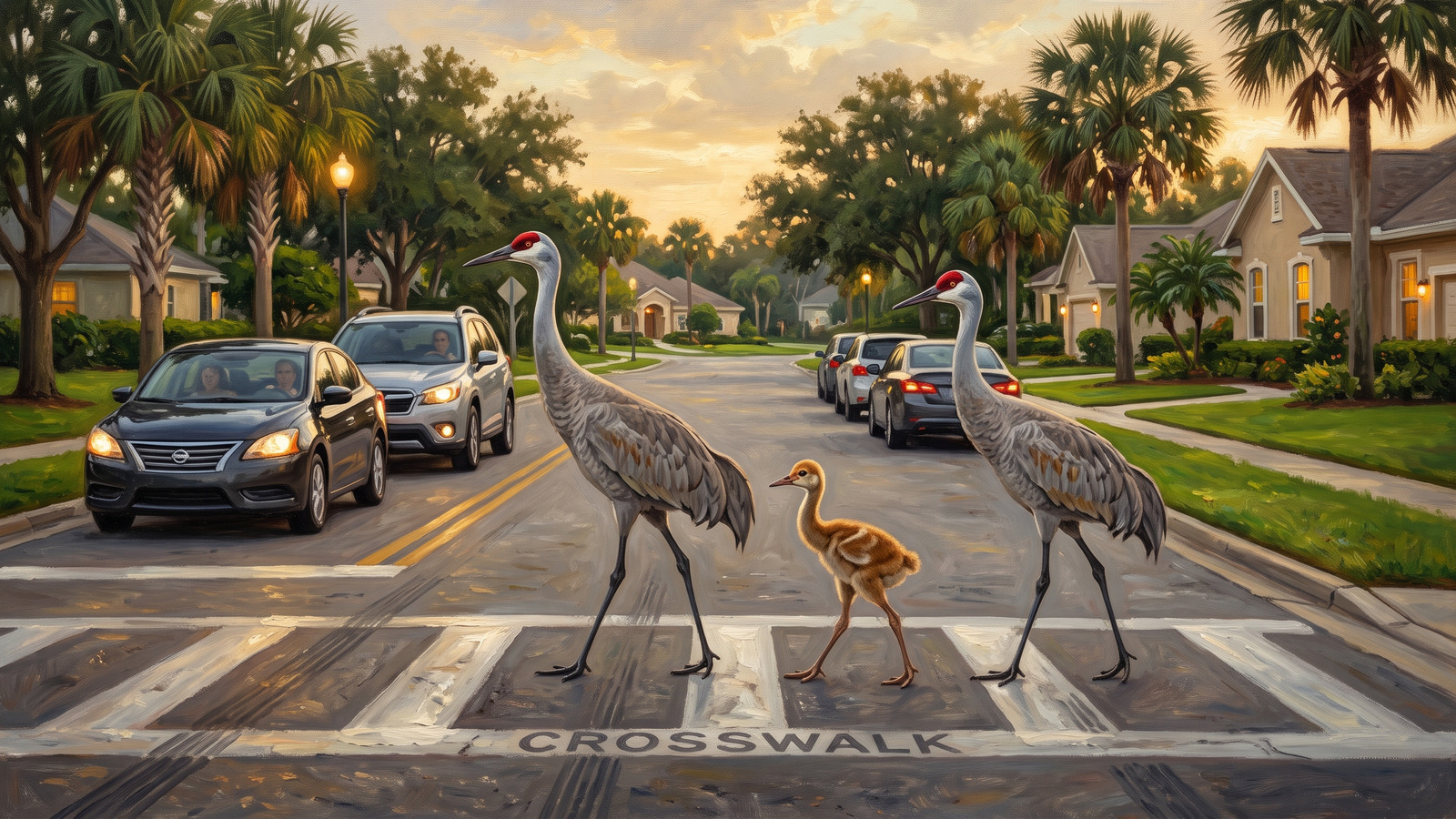
The school drop-off line is stopped, and nobody is honking, because what's crossing the road is a bird nearly four feet tall, walking with the unhurried confidence of a retired judge, followed by a spouse and two fuzzy, knee-high chicks. Cars wait. Phones come out. Somewhere in the second minivan a kid asks the exact right question: why does a bird get to do that? In Florida, the honest answer is seniority.
A bird older than the roads, by a lot
Sandhill cranes belong to one of the oldest bird lineages still walking the planet, with Florida fossils of crane relatives dating back over two million years. The birds standing on your sidewalk are, give or take, the same design that watched mammoths cross this peninsula. Kids should get to hold that fact while looking at one: the gray plume, the red crown, the golden eye. Then hand them the second fact: Florida's resident subspecies numbers only in the low thousands and is listed as state threatened, mostly because the prairies and shallow wetlands it needs became parking lots and lawns. The cranes stayed anyway. Which is why they're in the drop-off line.
Every winter the locals get company: tens of thousands of migratory greater sandhill cranes fly south to spend the season in Florida's pastures and marshes. A big winter flock feeding in a field is a visiting congregation; the year-round pair by the retention pond is the home parish.
The soundtrack and the dance
You'll hear cranes before you see them. The call is a rolling, prehistoric bugle produced by a windpipe coiled like a French horn, and a duetting pair can carry for a mile or more. And then there's the dance: bowing, leaping, wing-spreading, grass-tossing, performed most in courtship season but really available any time a crane feels like it. A family that catches a full dance in a suburban front yard has seen one of North America's great wildlife displays, for free, before breakfast.
The family unit is easy to read: pairs mate for long-term partnership, nest in shallow wetland vegetation, and raise one or two chicks, called colts because they walk within a day, gangly and rust-colored, shadowing their parents for most of a year. The trio crossing the road in June is a household.
The two rules of crane country
Rule one: never feed them. This one carries the force of law: intentionally feeding sandhill cranes has been illegal in Florida since 2002, under the state code, and the reasoning is the same as for alligators and every other wild neighbor. A fed crane trades its wariness for handouts, starts approaching people, patios, and parked cars, and a four-foot bird with no fear of traffic has a short future. The cranes are magnificently capable of feeding themselves: watch one spear mole crickets and grubs out of a lawn and you'll realize they're doing free pest control the whole time.
Rule two: yield. Cranes walk their territories on daily rounds and cross roads at a stately pace on purpose: running triggers no instinct in them and never will. Slow down in crane neighborhoods, wait out the crossing, and teach young drivers in the house to do the same. The birds have the seniority; we have the brakes.
| Around the house | What's going on and what to do |
|---|---|
| Crane pecking your car or window | It's fighting its reflection; cover it or block the view for a few days |
| Cranes drilling holes in the lawn | Free grub removal; the lawn recovers, the invoice never comes |
| Colts in the yard in spring | Give the family room; parents are calm but present |
| Someone tossing them bread | That's the illegal part; a kind word about the law helps |
| Crane standing in the road, unbothered | Yield; you're in its living room, not the reverse |
Where to see them around Tampa Bay
Beyond your own subdivision (eastern Hillsborough, Pasco, and Polk neighborhoods see daily crane traffic), the reliable stages are the wet prairies at Circle B Bar Reserve near Lakeland, where cranes strut past strollers at conversational range, plus pastures and park edges from Brooksville to Sarasota. Winter widens the show as migratory flocks arrive. Bring the starter birding habits and a camera with some zoom; the birds will handle the posing.
The Little Naturalist activity
Keep a crane family diary. If a pair works your neighborhood or a park you visit weekly, have kids log each sighting: where, what the cranes were doing, whether colts are present and how tall they've gotten against a fence post or mailbox. Over a season the diary captures a full family saga, and if the pair dances, that page gets stars. It's territory mapping, the same method wildlife biologists use, running quietly alongside the school run.
Questions families ask
Are sandhill cranes dangerous to kids or pets?
They're not aggressive toward people who give them space, though a parent crane will posture (wings out, hissing) if someone crowds a colt, which is fair. Keep dogs leashed around crane families and admire from a respectful distance; the birds keep the peace if we do.
Why do they scream at dawn?
The bugling is contact calling and territory announcement, loudest in early morning and in season. It's the sound Florida's prairies have made for two million years; earplugs are cheaper than the alternative, which is a Florida without it.
Are these the same as whooping cranes?
No; whooping cranes are white, critically endangered, and vanishingly rare in Florida today. A tall gray bird with a red crown is a sandhill. If you genuinely see an all-white crane with black wingtips, report it to FWC, because you've had a very notable morning.
Can we do anything to help beyond not feeding them?
Vote for wet, wild yard corners: shallow rain gardens and unmown edges feed the food cranes eat. Support prairie and wetland preserves like Circle B with your visits. And keep raising kids who wait out the crossing without honking; the crane's whole survival plan is a neighborhood that considers them neighbors.
Questions families ask
Why are sandhill cranes walking through my Florida neighborhood?
Because the neighborhood was built on their prairie. Florida's resident sandhill cranes historically lived in open grasslands and shallow wetlands, and as those became subdivisions and golf courses, the cranes simply kept the address. The pair on your street likely holds a territory that predates the houses.
Is it illegal to feed sandhill cranes in Florida?
Yes, since 2002 under Florida Administrative Code 68A-4.001(6). Fed cranes lose their wariness, start approaching people, cars, and windows, and usually come out of that bargain injured or worse. Admire them at a distance and let them find their own grubs.
Do sandhill cranes mate for life?
Generally, yes. Pairs stay together year after year, defend the same territory, and perform leaping, bowing dance displays that families are sometimes lucky enough to watch in a front yard. The fuzzy colts walking with them are this year's chicks, usually one or two.
What's the difference between the cranes here in summer versus winter?
Florida has a resident subspecies, several thousand birds that live here all year and are listed as state threatened, and each winter tens of thousands of migratory sandhill cranes fly down to join them. Winter flocks in a pasture are visitors; the pair strolling past the mailbox in July is local.
Sources
More from the Bae
 LearnCornerstone
Florida's State Symbols, Explained for Kids: Every Animal, Flower, and Song, and the Stories Behind Them
Every Florida state symbol explained for kids: the panther, manatee, mockingbird, zebra longwing, and more, with the stories and the flamingo debate.
 LearnCornerstone
Birding with Kids Around Tampa Bay: The Starter Guide (Binoculars Optional)
How to start birding with kids around Tampa Bay: the big easy birds, the free Merlin app, five starter spots, and habits that make it stick.
 Learn
LearnBackyard Bird Feeding in Florida: Who Shows Up, What to Offer, and What to Skip
Florida backyard bird feeding, done right: who visits, the painted bunting secret, hummingbird recipe, clean-feeder rules, and what never to feed.