
The Christmas Bird Count: How Your Family Can Join Science's Longest-Running Tradition
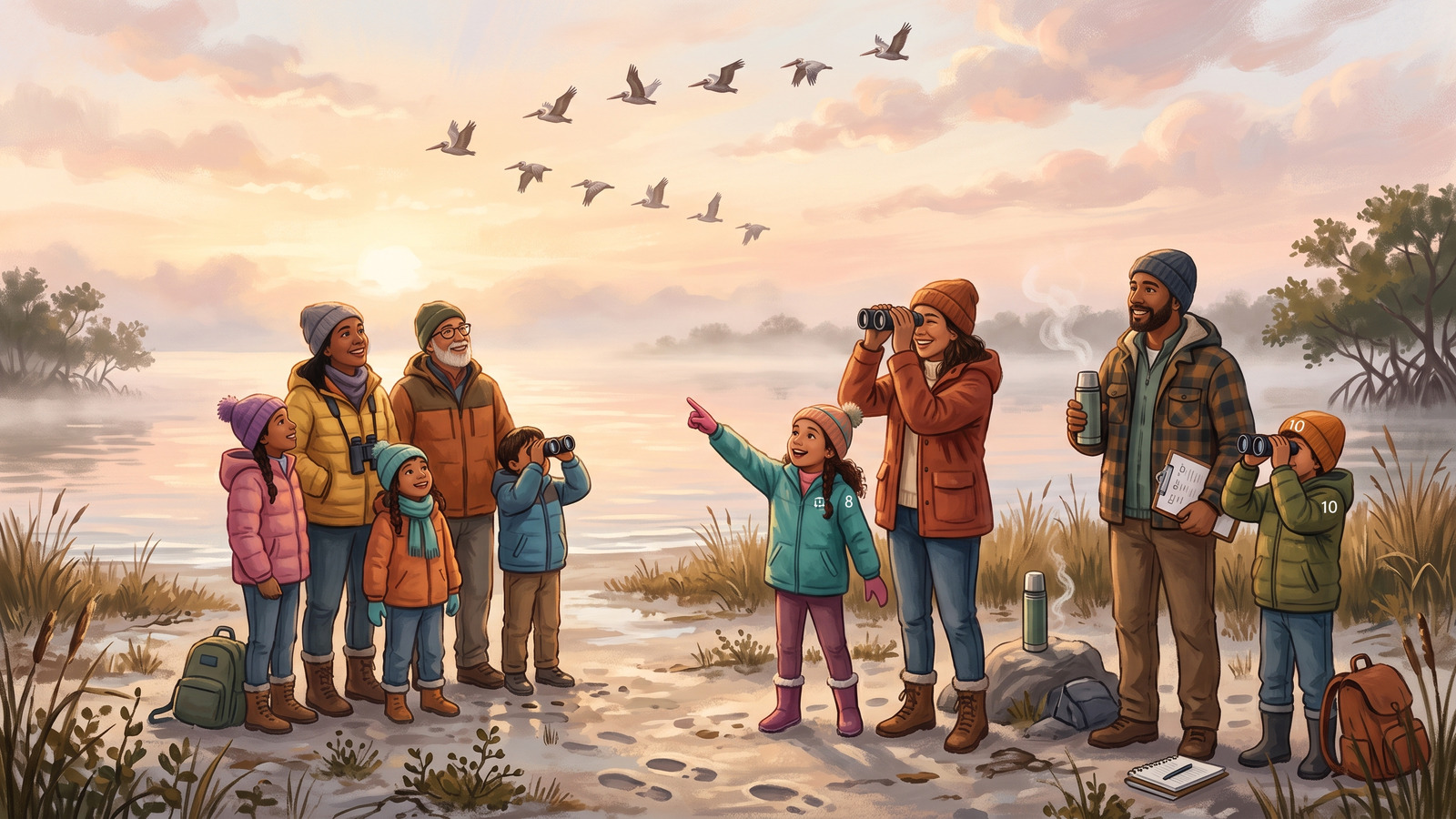
On Christmas Day in 1900, the fashionable holiday tradition among American sportsmen was the Side Hunt: teams fanned out and shot every bird and animal they could, and the biggest pile won. An ornithologist named Frank Chapman proposed a defiant alternative: go out the same day, in teams, and count the birds instead. Twenty-seven people joined him. This winter, somewhere around a quarter million people across the Americas will carry on what they started, and there is a spot on a team, or a post at your own kitchen window, reserved for your family.
How a count actually works
Each count happens inside a fixed circle 15 miles across, on one calendar day chosen by its volunteer compiler within the December 14 to January 5 window. The circle is carved into territories; small teams cover theirs from dawn (owlers start earlier, an adventure for older kids), counting not just species but individuals: every ibis in the flock, every yard cardinal, every one of the four hundred coots on the pond, tallied. At day's end, teams pool numbers, swap stories over chili (the potluck compilation dinner is its own tradition), and the compiler ships the circle's totals into a dataset that stretches back, unbroken, to 1900.
The rules' very rigidity is the magic: same circles, same window, same methods, year over year over century. That consistency is what lets scientists separate "a cold snap moved the robins" from "the robins are genuinely fewer," and it's why this cheerful holiday outing carries real analytical weight.
Why the data matters more than ever
Walk your kids through the chain: one morning's careful tally seems small; a circle's century of tallies shows local change; two thousand circles' centuries show a continent breathing. Christmas Bird Count data helped document the finding that North America has lost on the order of three billion birds since 1970, and it tracks winter ranges sliding north as climates shift: species your grandparents counted in Georgia now wintering in Carolina circles. When your seven-year-old writes "mockingbirds: 6" on a clipboard, that number joins the same dataset. There is no other homework assignment on Earth with a 127-year-old spine and a continental scope, and it costs nothing but a December morning.
The family on-ramps, easiest first
| Level | What it looks like |
|---|---|
| Feeder watcher | Live inside a circle? Count your feeder birds on count day and report to the compiler |
| Team tag-along | Join a territory team for the morning; kids spot, adults confirm, everyone tallies |
| The full day | Dawn to dusk with the team, potluck compilation dinner included |
| The owling add-on | Pre-dawn owl listening for brave older kids; headlamps, whispers, legends |
To join: Audubon's count page maps every circle with its compiler's contact. Tampa Bay hosts multiple long-running circles covering St. Petersburg, Clearwater, Tampa, and surrounding country, so nearly every local family lives in or near one. Email a few weeks ahead, say you're a family with kids and beginners, and ask for a gentle territory: compilers, who are perpetually recruiting the next generation, will treat you like found treasure. Beginners are explicitly welcome; every team pairs newcomers with veterans, and a child with sharp eyes is a genuine asset, since spotting is the skill that can't be taught and kids arrive with it.
Training camp: December's warm-up
A family that wants to arrive useful can train painlessly: run the starter guide's big five until they're automatic, practice counting flocks in tens at any pond (the professional trick: count ten, then count the tens), and let Merlin's sound ID tune everyone's ears on walks. None of it is required. All of it multiplies the fun, because the difference between watching birds and counting birds, kids discover, is the difference between watching a game and playing.
The Little Naturalist activity
Hold a practice count at home the week before: pick one hour, define your "circle" (the yard, the block, the park), and run it by real rules: every individual counted, every species logged, weather noted, results written up and posted on the fridge. Then do the same hour on the same route in January and compare. Two data points and a question ("where did the goldfinches go?") is the entire scientific method, staged in the driveway, and it makes the real count day feel like being called up to the majors.
Questions families ask
What if we can't identify much yet?
Come anyway; that's what the team structure is for. Veterans identify, beginners spot and tally, and one morning beside a sharp birder teaches more than a winter of apps. Circles have run on exactly this apprenticeship since 1900.
Is there a cost or registration?
Participation is free. Each circle's compiler handles signup informally by email, and feeder-watchers just need to connect with their circle's compiler before count day so the numbers land in the right column.
What birds will we actually count around Tampa Bay in December?
Winter is our high season: yard regulars plus goldfinch flocks, huge waterbird numbers, wintering warblers, and the shorebird crowds on the flats. Tampa Bay circles routinely post some of the healthiest species totals in the country, which makes local teams cheerful company.
We'll be traveling December 14 to January 5. Are we out?
Circles run throughout the window on different days, so check dates for circles near wherever you'll be: counting with a strange circle in a strange state is a beloved birder move, and a family that counts in two states over one holiday has stories, data, and possibly a new annual tradition.
Questions families ask
What is the Christmas Bird Count?
The longest-running community science project in the world: every year from December 14 through January 5, volunteers across the Americas count every bird they can find inside assigned 15-mile-wide circles, following rules Audubon has kept consistent since 1900. The data tracks how bird populations are changing across more than a century.
Can kids participate in the Christmas Bird Count?
Yes, and organizers actively welcome them: families join a circle's team for a morning, get paired with experienced counters, and kids serve as spotters and tally-keepers. Households living inside a count circle can even contribute by watching their own feeders on count day.
How do we join a count near Tampa Bay?
Through Audubon's Christmas Bird Count page, which maps every circle and lists each compiler's contact. The Tampa Bay area hosts several long-running circles (St. Petersburg, Clearwater, Tampa among them); email the compiler a few weeks ahead and ask for a family-friendly assignment.
Does the count actually matter scientifically?
Enormously: more than a century of standardized counts is how researchers documented continental bird declines and shifting winter ranges. When scientists reported North America had lost roughly three billion birds since 1970, Christmas Bird Count data was part of the evidence.
Sources
More from the Bae
 LearnCornerstone
Birding with Kids Around Tampa Bay: The Starter Guide (Binoculars Optional)
How to start birding with kids around Tampa Bay: the big easy birds, the free Merlin app, five starter spots, and habits that make it stick.
 Learn
LearnBaby Shorebirds on Our Beaches: What the Roped-Off Areas Protect, and How to Teach the Why
Those roped-off beach areas protect eggs and chicks you can't see: skimmers, terns, and plovers nesting February 15 to August 31 on Tampa Bay sand.
 Learn
LearnBackyard Bird Feeding in Florida: Who Shows Up, What to Offer, and What to Skip
Florida backyard bird feeding, done right: who visits, the painted bunting secret, hummingbird recipe, clean-feeder rules, and what never to feed.