
The Florida Panther: How Many Are Left, Where They Live, and How Kids Can Help
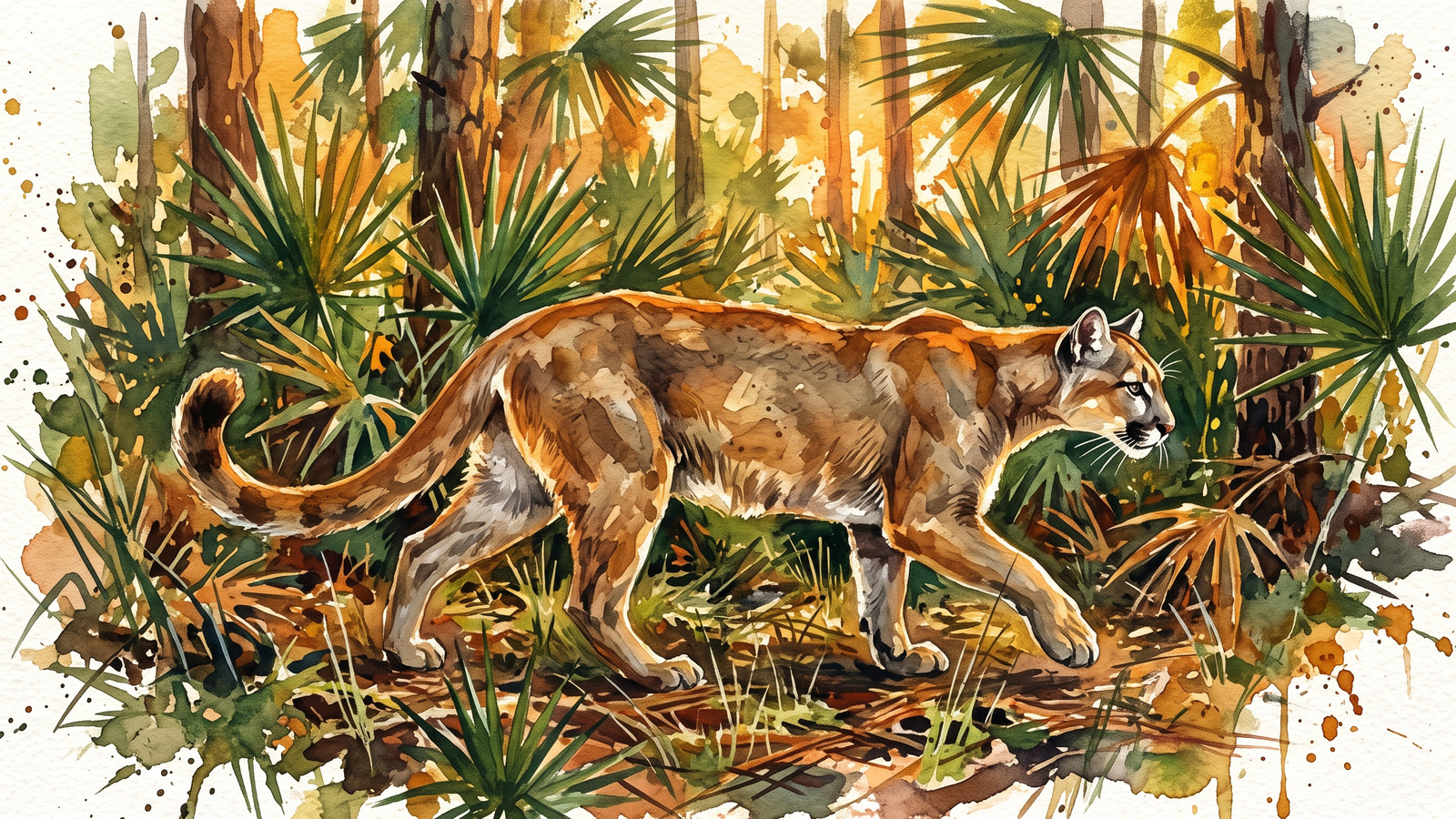
Your child's school mascot, the logo on the hockey jerseys, the face on a hundred Florida license plates: the state animal is everywhere in Florida except Florida. Fewer panthers live in the wild today than students in most elementary schools, and the whole population would fit in two school buses. That's the strange, hopeful math of the panther, and kids handle it better than adults do: they hear "only 200 left" and immediately want a job to do. Good. There are jobs.
What exactly is a Florida panther?
It's a puma, the same species as the cougars and mountain lions out west, but it's our own subspecies, tan as cured pine straw, never black, with a long tail that helps it steer through palmetto. Adults can top 100 pounds and roam territories the size of a whole city. Florida's is the only breeding puma population left anywhere east of the Mississippi, which is why the panther appears on the endangered species list and on so much Florida pride.
Kids' favorite fact: a panther can't roar. It chirps, whistles, and purrs, and a mother calling her kittens sounds more like a bird than a monster.
How close did we come to losing them?
By the early 1990s, biologists could count the remaining panthers in the teens and twenties, and the survivors were so closely related that health problems were stacking up. In 1995, wildlife managers tried something bold: they brought eight female pumas from Texas, the panther's nearest wild cousins, to refresh the family tree. It worked. Kittens got healthier, numbers climbed, and today's population of 120 to 230 descends from that rescue. Scientists call it genetic restoration. Tell kids the honest version: the panther nearly blinked out, people acted just in time, and the fix is still being finished.
Why are cars the main enemy now?
Because a panther's territory is bigger than the roads are far apart. Young males especially walk enormous distances hunting for unclaimed land, and they cross highways to do it. Vehicle strikes are the leading documented cause of panther deaths year after year, with more than a dozen killed on roads in a typical recent year. The fixes are real and working where they exist: wildlife underpasses with fencing that funnels animals safely beneath the highway, and posted panther speed zones at dusk and dawn, when tan cats and dim light are a bad mix.
The bigger fix has a name your kids should know: the Florida Wildlife Corridor, a statewide effort to keep wild lands connected so a panther (or a bear, or a tortoise) can travel from the Everglades toward north Florida without running out of green. For the population to truly recover, panthers need to expand north. Which means the corridor conversation runs straight through our part of the state.
Where panthers live, and whether you'll ever see one
| Question | Answer |
|---|---|
| Core range | Southwest Florida: Big Cypress, Everglades, Fakahatchee |
| Nearest to Tampa Bay | Wandering young males, occasionally verified in central Florida |
| Odds of seeing one in the wild | Very low, and panthers prefer it that way |
| Where families can see one for certain | Accredited zoos and wildlife centers around the state |
| What you probably saw in your neighborhood | A bobcat (short tail) or a well-fed house cat |
How kids can actually help
Slow down in panther country: if your family road-trips to the Everglades or Naples, the posted night speed zones are panther medicine, and kids make excellent backseat enforcers. Support the corridor: state parks and preserves along it, including ones near us, count visits and voices. Report sightings: FWC collects verified reports and tracks the population's edge as it expands. And adopt the habit of the accurate story: a kid who can explain that panthers aren't black, aren't around every corner, and aren't gone yet is doing real conservation work at the lunch table.
Where to learn more around Tampa Bay
No Tampa Bay preserve has wild panthers, and honesty about that is part of the lesson. What we do have: panther habitat's northern frontier a day trip south, excellent puma ambassadors at accredited facilities around the state, and the same sandhill and swamp habitats, in miniature, at places like Boyd Hill Nature Preserve, where kids can learn to read wild Florida. Pair this story with the gopher tortoise, the corridor's other famous resident, for a full picture of what connected land protects.
The Little Naturalist activity
Measure your backyard or a nearby park, then look up a panther territory (males can claim 200 square miles). Have your kids do the math on how many backyards make one panther's home. It lands the whole conservation story in one gasp, and it's the reason the corridor matters more than any single preserve.
Questions families ask
Has a panther ever hurt a person in Florida?
There is no documented panther attack on a human in Florida. Give wildlife room, keep pets leashed in wild areas, and the panther will handle the avoiding for both of you.
Why can't they just move panthers north to make more room?
Biologists have studied it, and the honest answer is that panthers mostly need safe passage to move themselves. Females expand range slowly, which is why the corridor and highway crossings matter more than relocation trucks.
What do panthers eat?
Mostly deer and wild hogs, with the occasional armadillo or raccoon. A healthy panther population is a sign the whole food web under it is working, which is why biologists call it an umbrella species: protect the panther's land and you shelter everything beneath.
Where did the state animal title come from?
A statewide vote of schoolchildren in 1982. Florida kids chose the panther over the alligator, and every Florida kid since has inherited a small share of the job. The full symbols story has the rest of the ballot.
Questions families ask
How many Florida panthers are left in the wild?
Current estimates put the population between 120 and 230 adults, nearly all in southwest Florida. That's up from perhaps 20 to 30 animals in the early 1990s, so the story is a comeback, but a fragile one: vehicle strikes kill a dozen or more panthers in a typical year.
Are there panthers near Tampa Bay?
Rarely, and almost always young males wandering north in search of territory. The breeding population lives south of the Caloosahatchee River, around Big Cypress and the Everglades. A verified panther near Tampa makes the news; a bobcat sighting happens every week and is what most people actually saw.
Is a Florida panther dangerous to people?
There has never been a documented panther attack on a person in Florida. Panthers avoid humans with great skill. The practical safety notes are for the panther: drive slowly in posted panther zones, especially at dusk and dawn.
What's the difference between a panther and a bobcat?
Size and tail. A panther is deer-sized with a long, thick tail; a bobcat is knee-high with a short, bobbed tail and spotted coat. Since panthers are tan (never black), most 'black panther' sightings are house cats at a flattering distance.
Sources
More from the Bae
 LearnCornerstone
Florida's State Symbols, Explained for Kids: Every Animal, Flower, and Song, and the Stories Behind Them
Every Florida state symbol explained for kids: the panther, manatee, mockingbird, zebra longwing, and more, with the stories and the flamingo debate.
 Learn
LearnThe Gopher Tortoise: Florida's Little Landlord and the 350 Neighbors in Its Burrow
The gopher tortoise digs burrows that shelter 350 other species. Where families can see Florida's little landlord, and the never-put-it-in-water rule.
 Learn
LearnManatees for Families: Where to See Them Near Tampa Bay and the Rules That Keep Them Safe
Where to see manatees near Tampa Bay: the free TECO Manatee Viewing Center opens November 1, plus the look-don't-touch rules families should know.